x


 Acrylic On CanvasWallArtNaive Art / Primitivism
 1942
1942 914.0 x 1524.0 cm
Hand-painted oil on canvas in your size and frame, made to order by our artists.





























Pick from our preset sizes that match the artwork's original proportions.

You may enter your own dimensions to fit a specific frame or space. If your selected size does not match the original image's proportions, we will either crop the artwork or extend the painting with additional hand-painted elements. A digital mockup will be sent for your approval before production begins.
Please note that the on-screen preview does not reflect the actual cropping or extension. Only the mockup will accurately show the final composition.
While custom sizes are available, we recommend selecting a dimension from the predefined list to preserve the original proportions.
Worldwide Delivery () in 3/4 weeks instead of standard 5 weeks. (18 July). No compromise on quality.


A wheatfield on a summer's afternoon
Reproduction Size
Marc Chagall, born Moishe Shagal in 1887 in the Belarusian town of Liozna near Vitebsk, wasn't merely a painter; he was a poet of color, a weaver of dreams, and a chronicler of memory. His life, spanning nearly a century, mirrored the tumultuous currents of the 20th century, yet his art remained steadfastly rooted in a deeply personal vision—one infused with the folklore of his Hasidic Jewish upbringing and an unwavering belief in the power of imagination. Vitebsk itself was more than just a birthplace; it became the emotional core of his artistic universe, a recurring motif populated by flying figures, whimsical animals, and the vibrant hues of remembered landscapes.
Chagall's artistic journey took an unexpected turn when he was commissioned to design scenery and costumes for Aleko, a ballet based on Pushkin’s romantic poem “The Gypsies” and choreographed by Dmitri Shostakovich. This collaboration profoundly influenced his creative process; Chagall sought to "penetrate Aleko without illustrating, without copying anything... I want the color to play and speak alone." Recognizing this ambition, he embraced Naive Art / Primitivism—a stylistic approach prioritizing spontaneity and directness—to convey the ballet’s atmosphere.
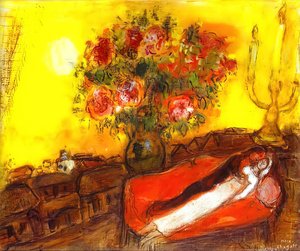
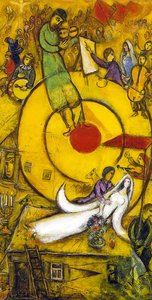
“A Wheatfield on a Summer's Afternoon,” created in 1942 during his six-year exile in the United States, exemplifies Chagall’s distinctive style. The painting eschews complex symbolism, opting instead for an explosion of color—primarily oranges and yellows—that dominates the canvas. A colossal orange sun ascends majestically above a tranquil wheatfield rendered in warm browns, creating a visual centerpiece. Beneath it, two distinct areas unfold: on the left, a field of golden wheat stretches towards the horizon; on the right, a serene blue boat drifts across shimmering water.
Executed in tempera—a medium known for its matte finish—the painting embodies the principles of Naive Art / Primitivism. Chagall’s technique prioritizes expressive brushstrokes and flattened perspectives, rejecting academic conventions to capture a feeling rather than an exact representation. This deliberate simplification enhances the artwork's dreamlike quality, transporting viewers into a realm where logic yields to imagination.
"A Wheatfield on a Summer's Afternoon" stands as a testament to Chagall’s versatility and artistic vision—a captivating backdrop for Aleko that continues to inspire artists and collectors alike. Its enduring appeal lies in its ability to evoke feelings of peace, nostalgia, and wonder. You can explore this masterpiece and many others by Chagall at Most-Famous-Paintings.com where you can find hand-made reproductions of exceptional quality.

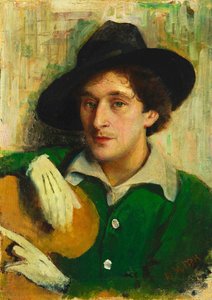
1887 - 1985 , Belarus
Journey into the dreamlike world of Marc Chagall! Explore 25 iconic paintings, from 'I and the Village' to his vibrant surrealist masterpieces. Discover the stories & techniques behind these timeless artworks – find museum-quality Chagall reproductions on Most-Famous-Paintings.com.

Journey through 25 iconic artworks at the Metropolitan Museum of Art! Explore Van Gogh, Monet, Rembrandt & more. Discover art history, inspiring stories, and museum-quality reproductions to elevate your home decor. Explore the full collection on Most-Famous-Paintings.com.
Journey through 25 iconic James Abbott McNeill Whistler paintings! Explore his masterpieces of Aestheticism, from 'Nocturne in Black and Gold' to captivating portraits. Find museum-quality art reproductions & elevate your home decor with Most-Famous-Paintings.com. Discover the full collection online.
Journey through Henri Matisse's 25 most iconic paintings! Explore Fauvism, vibrant colors & the stories behind masterpieces like 'The Dance'. Find museum-quality art reproductions and curated decor ideas to elevate your space. Discover all masterpieces on Most-Famous-Paintings.com.
Explore 25 iconic artworks from Washington DC's National Gallery of Art! Discover masterpieces by Cézanne, Matisse & Picasso. Find museum-quality art reproductions and elevate your home decor with timeless paintings. Explore the full collection online at Most-Famous-Paintings.com.


Stay updated with the latest art news, exclusive offers, and decoration ideas.
Tell us about your project and our art experts will provide you with 3 personalized art suggestions.
Let Us Curate 3 Options Just for You - Free!


 Buy print
 Send
Send Share
Share
 Details

 Download
 Similars
 X-Ray
X-Ray Diaporama
 Read More







 Glass option is only available in size under 110 CM