An Angel Painter: A Glimpse into Marc Chagall’s Dreamscape
Marc Chagall, a name synonymous with vibrant color and deeply personal symbolism, remains one of the 20th century's most beloved artists. His work transcends mere representation, offering instead a window into his own rich inner world – a world populated by fantastical figures, biblical narratives, and fragments of memory. Amongst his vast oeuvre, “An Angel Painter” (1928), housed within Most-Famous-Paintings’s exquisite hand-painted reproductions, stands as a particularly poignant example of this unique artistic vision. Created during a pivotal period in Chagall's career – a time when he was deeply immersed in the avant-garde circles of Paris – the painting is not simply a depiction of an angel; it’s a self-portrait rendered through the lens of his distinctive Naïve Art style, a style that deliberately eschews academic precision for raw emotion and intuitive expression.
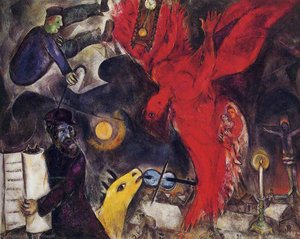
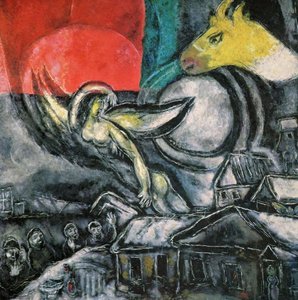
The scene unfolds within a simple, almost childlike church setting. A doorway dominates the composition, framed by a modest building – a structure suggesting both sanctuary and earthly connection. Standing before this entrance is a figure, unmistakably Chagall himself, holding a paintbrush aloft as if to capture the divine light streaming from above. This gesture immediately establishes the painting’s central theme: the artist's role as a conduit between the spiritual and the material realms. The presence of several other figures – some engaged in artistic pursuits, others seemingly observing with quiet contemplation – adds layers of narrative complexity without disrupting the overall dreamlike atmosphere. A bird, rendered with characteristic Chagallian exuberance, circles overhead, symbolizing freedom, hope, and perhaps even divine guidance. The color palette is dominated by rich blues, yellows, and reds—colors that evoke both the warmth of human emotion and the luminosity of spiritual experience.
“An Angel Painter” firmly places itself within the context of Naïve Art (Primitivism), a movement characterized by its directness, simplicity, and rejection of traditional artistic conventions. Artists associated with this style often lacked formal training but possessed an extraordinary ability to convey powerful emotions through bold colors, flattened perspectives, and symbolic imagery. Chagall’s work embodies these qualities perfectly; his brushstrokes are loose and expressive, his forms simplified, and his use of color intensely vibrant. Interestingly, the Naïve Art movement was not entirely dismissed by the established art world. In fact, it gained a certain prestige as “pseudo-naïve” or “faux naïve,” with trained artists deliberately adopting this style to tap into its raw emotional power. This deliberate mimicry highlights the enduring appeal of Naïve Art’s uninhibited expression and its ability to bypass intellectual analysis in favor of direct feeling.
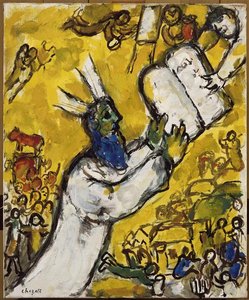
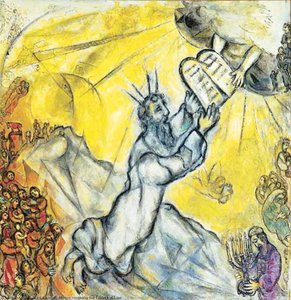
The painting's historical context is crucial to understanding its deeper meaning. In the 1920s, Chagall was experiencing a period of intense creative ferment in Paris, surrounded by fellow avant-garde artists like Pablo Picasso and Henri Matisse. This environment profoundly influenced his work, leading him to incorporate more abstract elements while retaining his signature dreamlike imagery. “An Angel Painter” can be interpreted as a reflection of this transformative period – a visual representation of Chagall’s own artistic journey, grappling with the challenges and possibilities of modern art. Furthermore, it echoes themes prevalent in Chagall's broader body of work, particularly his explorations of Jewish folklore, biblical narratives, and the complexities of human relationships. The painting resonates with other iconic works like “Abraham is going to sacrifice his son,” "Study to Jacob Wrestling with the Angel," and "Moses and Aaron," all of which share a common thread of spiritual searching and emotional intensity.
Most-Famous-Paintings’s hand-painted reproductions capture the essence of “An Angel Painter” with remarkable fidelity, preserving the artist's unique style and vibrant color palette. Each reproduction is meticulously crafted by skilled artists who have painstakingly recreated Chagall’s vision, ensuring that art enthusiasts can experience this masterpiece in all its glory. Available in a range of sizes and framing options, this stunning artwork offers an exceptional opportunity to own a piece of Chagall's extraordinary legacy – a testament to the power of imagination and the enduring beauty of Naïve Art. Explore more of Marc Chagall’s masterpieces at Most-Famous-Paintings.com/MarcChagall.
Key Features & Technical Details
- Artist: Marc Chagall
- Title: An Angel Painter
- Year: 1928
- Style: Naïve Art (Primitivism)
- Medium: Gouache and Watercolor on Paper
- Dimensions: 66.3 x 51.6 cm
Symbolism & Interpretation
The painting is rich in symbolic meaning, inviting multiple interpretations. The angel figure undoubtedly represents Chagall himself, engaged in the act of creation and seeking divine inspiration. The church doorway symbolizes both earthly existence and access to the spiritual realm. The bird embodies freedom, hope, and perhaps even a connection to the heavens. The other figures likely represent fellow artists or individuals associated with the artistic community of Paris during this period. Overall, “An Angel Painter” is a meditation on the role of the artist, the pursuit of beauty, and the search for meaning in a rapidly changing world.
Own a Piece of Art History
Most-Famous-Paintings’s hand-painted reproductions offer an unparalleled opportunity to own a genuine representation of Marc Chagall's “An Angel Painter.” Each reproduction is created with meticulous attention to detail, capturing the artist’s unique style and vibrant color palette. Discover more about Marc Chagall and explore other masterpieces at Most-Famous-Paintings.com/MarcChagall.