x


Hand-painted oil on canvas in your size and frame, made to order by our artists.
Pick from our preset sizes that match the artwork's original proportions.

You may enter your own dimensions to fit a specific frame or space. If your selected size does not match the original image's proportions, we will either crop the artwork or extend the painting with additional hand-painted elements. A digital mockup will be sent for your approval before production begins.
Please note that the on-screen preview does not reflect the actual cropping or extension. Only the mockup will accurately show the final composition.
While custom sizes are available, we recommend selecting a dimension from the predefined list to preserve the original proportions.
Worldwide Delivery () in 3/4 weeks instead of standard 5 weeks. (18 July). No compromise on quality.


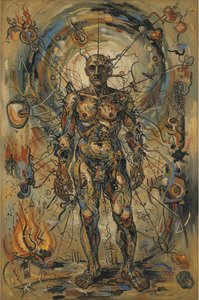
Tchitchikov's dreams
Reproduction Size
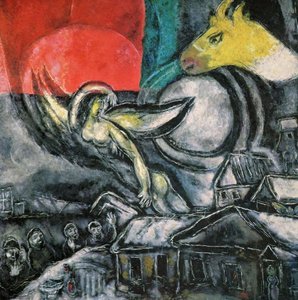
Marc Chagall's “Tchitchikov’s Dreams,” painted circa 1923, isn’t merely a depiction of a scene; it’s an immersion into the artist’s intensely personal and profoundly imaginative world. Born Moishe Shagal in Belarus, Chagall carried within him the vibrant folklore of his Jewish upbringing – a tapestry woven with religious symbolism, fantastical creatures, and a deep-seated belief in the power of dreams. This particular work, created during a period of significant artistic evolution for Chagall, embodies this spirit perfectly, offering a glimpse into a subconscious realm rendered with characteristic boldness and emotional resonance.
The painting immediately captivates with its dreamlike quality – a monochrome study dominated by shades of gray and black against a stark white background. This restricted palette amplifies the sketch-like feel, lending an immediacy and raw energy to the composition. Lines are not precise or realistic; instead, they’re loose, expressive, and deliberately curved, contributing significantly to the overall sense of movement and instability. The absence of a clear horizon line further enhances this feeling of suspension, as if the scene exists outside conventional spatial constraints – a hallmark of Chagall's style.
At first glance, “Tchitchikov’s Dreams” appears chaotic, yet within that apparent disorder lies a carefully constructed narrative. A prominent carriage, pulled by what resemble fantastical horses or perhaps even winged creatures, dominates the central space. Figures – some riding, others emerging from the landscape – are scattered throughout, adding to the sense of an unfolding story. Crescent moon shapes float serenely in the upper portion of the frame, echoing the dreamlike atmosphere and hinting at themes of mystery and spirituality. The painting draws inspiration from folklore and literary narratives, possibly referencing Gogol’s “Dead Souls,” a work that deeply influenced Chagall's artistic vision during this period.
The composition isn’t about realistic representation; it’s about conveying feeling and suggestion. Chagall masterfully utilizes overlapping shapes – the angular carriage juxtaposed against the organic curves of the landscape – to create depth and visual interest without relying on traditional perspective. The figures are rendered with simplified forms, emphasizing their emotional state rather than their individual details.
The recurring motif of crescent moons is particularly potent in “Tchitchikov’s Dreams.” Throughout his work, Chagall frequently employed this symbol to represent dreams, the subconscious, and a connection to something beyond the tangible world. The carriage itself can be interpreted as a vehicle for transformation – a journey through the landscape of the mind. The scattered figures evoke a sense of disorientation and wonder, mirroring the experience of being lost within a dream.
The overall mood is undeniably melancholic yet imbued with a whimsical charm. There’s an underlying feeling of longing or nostalgia, perhaps reflecting Chagall's own experiences as an immigrant navigating new cultures and landscapes. The painting invites viewers to contemplate their own dreams and the mysteries that lie beneath the surface of everyday reality.
“Tchitchikov’s Dreams” exemplifies Chagall’s distinctive artistic style, a potent blend of Cubism, Expressionism, and Symbolism. He employed quick, gestural lines and shading to capture the essence of the scene – prioritizing emotional impact over meticulous detail. The use of hatching and cross-hatching creates tonal variations and suggests depth, adding texture to the otherwise simplified forms. The artwork was likely created using graphite or charcoal on paper, lending it a raw, immediate quality.
This painting stands as a testament to Chagall’s unique vision – a world where reality and fantasy intertwine, where folklore and memory converge, and where the power of dreams reigns supreme. Reproductions offer an accessible way to bring this captivating dreamscape into your home, allowing you to experience the emotional depth and artistic brilliance of one of the 20th century's most beloved artists.
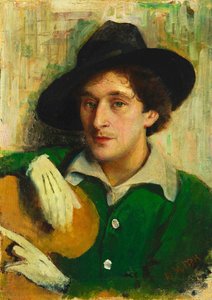
1887 - 1985 , Belarus
Journey into the surreal world of Max Ernst! Explore 25 iconic paintings, from Dada to abstract expressionism. Discover the stories behind his masterpieces & find museum-quality art reproductions for your home decor at Most-Famous-Paintings.com.
Journey into the dreamlike world of Marc Chagall! Explore 25 iconic paintings, from 'I and the Village' to his vibrant surrealist masterpieces. Discover the stories & techniques behind these timeless artworks – find museum-quality Chagall reproductions on Most-Famous-Paintings.com.

Explore the captivating world of Sidney Herbert Sime, a visionary British fantasy artist. Discover his unique style, partnership with Lord Dunsany, and enduring legacy through Most-Famous-Paintings.

Explore the captivating world of Pop Surrealism with Most-Famous-Paintings. Discover key artists like George Condo & Robert Williams, investment potential, and the movement's cultural impact. Expert insights for collectors.
Explore the revolutionary art of André Masson – pioneer of automatism & Surrealist expression. Discover his powerful imagery, innovative techniques, and lasting influence on modern art. Learn more at Most-Famous-Paintings.


Stay updated with the latest art news, exclusive offers, and decoration ideas.
Tell us about your project and our art experts will provide you with 3 personalized art suggestions.
Let Us Curate 3 Options Just for You - Free!


 Buy print
 Send
Send Share
Share
 Details

 Download
 Similars
 X-Ray
X-Ray Diaporama

 Read More




































 Glass option is only available in size under 110 CM