x


Hand-painted oil on canvas in your size and frame, made to order by our artists.
Pick from our preset sizes that match the artwork's original proportions.

You may enter your own dimensions to fit a specific frame or space. If your selected size does not match the original image's proportions, we will either crop the artwork or extend the painting with additional hand-painted elements. A digital mockup will be sent for your approval before production begins.
Please note that the on-screen preview does not reflect the actual cropping or extension. Only the mockup will accurately show the final composition.
While custom sizes are available, we recommend selecting a dimension from the predefined list to preserve the original proportions.
Worldwide Delivery () in 3/4 weeks instead of standard 5 weeks. (18 July). No compromise on quality.


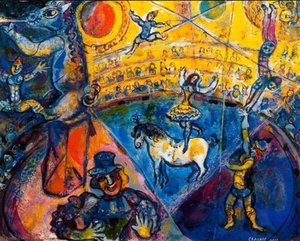
The heart of the circus
Reproduction Size
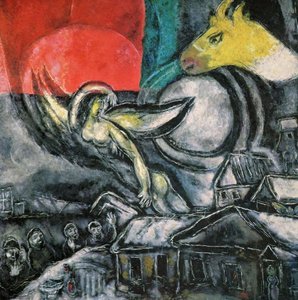
Marc Chagall’s “The Heart of the Circus,” painted in 1962, isn't merely a depiction of a traveling show; it’s an immersion into a vibrant, dreamlike world brimming with memory and emotion. This lithograph, executed in a style often categorized as Naïve Art (or Primitivism), transcends simple representation to become a potent distillation of Chagall’s personal mythology and his enduring fascination with the folklore of his Jewish heritage. The painting pulsates with an almost feverish energy, drawing the viewer into a chaotic yet strangely harmonious tableau – a stage where reality and fantasy blur, and the familiar becomes imbued with symbolic weight.
At first glance, the scene appears delightfully disorienting. A riot of color dominates: fiery oranges and reds clash playfully with deep blues and greens, creating an immediate sense of dynamism. The composition is deliberately unbalanced, a hallmark of Chagall’s style, contributing to the feeling that we've stumbled upon a secret world glimpsed through a hazy recollection. The figures – a diverse cast of animals and humans – are rendered with a bold simplicity, their forms often elongated and slightly distorted, echoing the artist’s own recollections and his desire to bypass rational representation in favor of emotional truth.
To truly appreciate “The Heart of the Circus,” it’s essential to understand Chagall’s formative years. Born Moishe Shagal in 1887 in Liozna, Belarus—a small town steeped in both Russian and Jewish culture—Chagall's early life profoundly shaped his artistic vision. Vitebsk, his birthplace, became a recurring motif throughout his work, representing not just a geographical location but also the emotional core of his being. The town’s unique blend of Orthodox churches and bustling marketplaces, its layered history and diverse population, provided a rich tapestry of imagery that he would continually revisit in his paintings.
The influence of Hasidic Jewish folklore is particularly evident here. Chagall frequently employed elements from Jewish tradition – flying figures, dancing couples, animals imbued with symbolic meaning – to explore themes of faith, memory, and the longing for a lost homeland. The presence of the tigers, for instance, can be interpreted as representing both power and vulnerability, echoing ancient Jewish legends. The painting’s overall atmosphere evokes a sense of nostalgia—a yearning for a simpler time, a connection to ancestral roots, and perhaps even a bittersweet recognition of the passage of time.
Beyond the immediate visual impact, “The Heart of the Circus” is laden with symbolic details. The central horse, its head bowed as if exhausted or contemplative, could represent both the spectacle itself and the burden of performance. The two birds soaring above suggest freedom and aspiration, while the handbag at the bottom left corner—a seemingly mundane object—might symbolize domesticity, memory, or perhaps even a lost love. Even the acrobats and performers contribute to this complex web of meaning, representing humanity’s desire for entertainment and transcendence.
The lithograph technique itself contributes to the painting's dreamlike quality. Chagall utilized bold lines and flat planes of color, reminiscent of children’s drawings or folk art—a deliberate choice that stripped away any sense of photographic realism and emphasized the emotional impact of the image. The vibrant hues are particularly striking when reproduced, creating a rich tapestry of color that invites close inspection and contemplation.
Most-Famous-Paintings offers meticulously crafted hand-painted reproductions of “The Heart of the Circus,” allowing you to bring this iconic masterpiece into your home or office. Our skilled artists faithfully recreate Chagall’s distinctive style, capturing not only the visual details but also the emotional intensity and dreamlike atmosphere of the original painting. Whether you're an art collector, a design enthusiast, or simply someone seeking a piece of art that sparks conversation and evokes emotion, our reproductions provide a beautiful and authentic way to experience the enduring power of Marc Chagall’s vision. Explore our collection today and discover the perfect way to celebrate this extraordinary work of art.
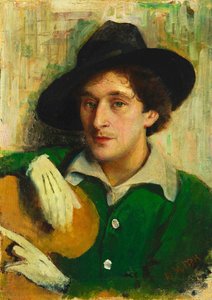
1887 - 1985 , Belarus
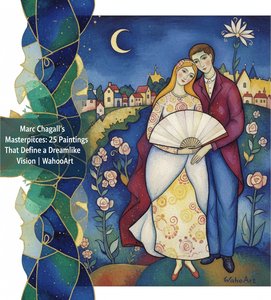
Journey into the dreamlike world of Marc Chagall! Explore 25 iconic paintings, from 'I and the Village' to his vibrant surrealist masterpieces. Discover the stories & techniques behind these timeless artworks – find museum-quality Chagall reproductions on Most-Famous-Paintings.com.
Delve into the world of Francisco Goya with Most-Famous-Paintings. Explore 25 iconic paintings – from 'The Third of May' to his haunting Black Paintings. Discover the stories, techniques & emotions behind these Spanish masterpieces. Find museum-quality art reproductions for your home at Most-Famous-Paintings.com!
Journey into the surreal world of Max Ernst! Explore 25 iconic paintings, from Dada to abstract expressionism. Discover the stories behind his masterpieces & find museum-quality art reproductions for your home decor at Most-Famous-Paintings.com.
Explore 25 iconic Joan Miró paintings! Discover the stories behind his Surrealist masterpieces, vibrant colors & unique style. Find museum-quality Miro reproductions and elevate your home decor with Most-Famous-Paintings.com. Explore the full collection online.

Discover the captivating world of Maria Primachenko, Ukraine's celebrated naive artist. Explore her vibrant paintings, unique style, and enduring legacy with Most-Famous-Paintings – your source for authentic art insights & reproductions.


Stay updated with the latest art news, exclusive offers, and decoration ideas.
Tell us about your project and our art experts will provide you with 3 personalized art suggestions.
Let Us Curate 3 Options Just for You - Free!


 Buy print
 Send
Send Share
Share
 Details

 Download
 Similars
 X-Ray
X-Ray Diaporama

 Read More




































 Glass option is only available in size under 110 CM