x


 EtchingNaive Art/Primitivism
 1931
1931 31.0 x 24.0 cm
Hand-painted oil on canvas in your size and frame, made to order by our artists.





























Pick from our preset sizes that match the artwork's original proportions.

You may enter your own dimensions to fit a specific frame or space. If your selected size does not match the original image's proportions, we will either crop the artwork or extend the painting with additional hand-painted elements. A digital mockup will be sent for your approval before production begins.
Please note that the on-screen preview does not reflect the actual cropping or extension. Only the mockup will accurately show the final composition.
While custom sizes are available, we recommend selecting a dimension from the predefined list to preserve the original proportions.
Worldwide Delivery () in 3/4 weeks instead of standard 5 weeks. (18 July). No compromise on quality.


The monument on the tomb of Rachel, on the path Ephra (Genesis XXXV, 19 20)
Reproduction Size
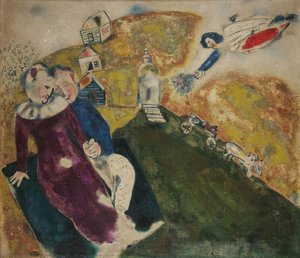
Marc Chagall's 1931 etching, “The Monument on the Tomb of Rachel, on the path Ephra (Genesis XXXV, 19 20),” is far more than a simple depiction of a biblical scene; it’s a profound exploration of memory, faith, and the enduring power of folklore. Born into a world steeped in Jewish tradition in Vitebsk, Belarus – a city that would forever haunt his artistic vision – Chagall imbued this work with the vibrant colors and symbolic weight of his upbringing. The etching, rendered in meticulous detail despite its black-and-white format, transports us to a landscape both familiar and dreamlike, echoing the artist’s deeply personal connection to his roots.
The composition immediately draws the eye to a solitary camel traversing a dusty path leading towards a weathered building that subtly resembles an ancient church or perhaps a modest dwelling. Two figures stand in the foreground – one positioned on the left, partially obscured, and another closer to the right, gazing out at the scene. This deliberate ambiguity invites contemplation; are they mourners? Pilgrims? Witnesses to a timeless event? The architectural element, with its distinctive dome-like structure, adds an intriguing layer of visual complexity, hinting at both earthly solidity and spiritual aspiration.
This etching directly references Genesis 35:19-21, recounting Rachel’s death on the journey to Bethlehem and Jacob's act of erecting a monument – a pillar – over her grave. However, Chagall doesn’t offer a literal representation of this event. Instead, he captures the *feeling* of it—the sense of loss, pilgrimage, and remembrance. The camel itself is a potent symbol, representing both travel and burden, linking the earthly journey with the spiritual one. The building, while vaguely ecclesiastical, could also be interpreted as a representation of the Jewish community’s connection to faith and tradition, standing as a silent witness to this pivotal moment.
Chagall's signature style—often described as Naïve Art or Primitivism—is evident in the simplified forms, bold colors (though rendered in monochrome here), and expressive brushwork. He eschews academic precision for a directness of feeling, prioritizing emotional resonance over realistic depiction. This approach aligns with his broader artistic philosophy, rooted in the folklore and storytelling traditions of his childhood.
Created during a period of significant personal and political upheaval – the rise of fascism in Europe – “The Monument on the Tomb of Rachel” offers a glimpse into Chagall's inner world. Vitebsk, with its blend of Orthodox churches and Jewish marketplaces, served as a constant source of inspiration for him, shaping his unique visual language. The etching reflects this duality—a harmonious juxtaposition of religious and secular elements, tradition and modernity. It’s a testament to the artist’s ability to distill complex emotions and narratives into a single, evocative image.
The meticulous detail in the etching's execution, despite its monochrome palette, speaks volumes about Chagall’s artistic discipline and his commitment to capturing every nuance of the scene. It’s a work that rewards repeated viewing, revealing new layers of meaning with each encounter. The piece stands as a powerful reminder of the enduring legacy of faith, memory, and the transformative power of art.

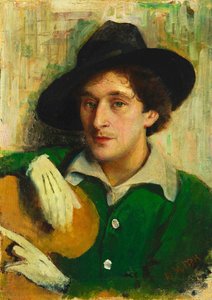
1887 - 1985 , Belarus
Journey into the dreamlike world of Marc Chagall! Explore 25 iconic paintings, from 'I and the Village' to his vibrant surrealist masterpieces. Discover the stories & techniques behind these timeless artworks – find museum-quality Chagall reproductions on Most-Famous-Paintings.com.

Journey through 25 iconic artworks at the Metropolitan Museum of Art! Explore Van Gogh, Monet, Rembrandt & more. Discover art history, inspiring stories, and museum-quality reproductions to elevate your home decor. Explore the full collection on Most-Famous-Paintings.com.

Journey through 10 legendary etching masterpieces by Rembrandt, Dürer & Goya. Explore the history of printmaking and discover timeless art for your home. Find museum-quality reproductions at Most-Famous-Paintings.com.

Journey through 25 iconic James Abbott McNeill Whistler paintings! Explore his masterpieces of Aestheticism, from 'Nocturne in Black and Gold' to captivating portraits. Find museum-quality art reproductions & elevate your home decor with Most-Famous-Paintings.com. Discover the full collection online.

Journey through 25 iconic artworks at the Detroit Institute of Arts! Explore Van Gogh, Monet, Rembrandt & more. Discover art history, stunning techniques & find museum-quality reproductions to elevate your home decor on Most-Famous-Paintings.com.


Stay updated with the latest art news, exclusive offers, and decoration ideas.
Tell us about your project and our art experts will provide you with 3 personalized art suggestions.
Let Us Curate 3 Options Just for You - Free!


 Buy print
 Send
Send Share
Share
 Details

 Download
 Similars
 X-Ray
X-Ray Diaporama
 Read More







 Glass option is only available in size under 110 CM