x


 Acrylic On CanvasWallArtRenaissance
 1494Renaissance
 292.0 x 200.0 cm
 Graphische Sammlung Albertina
Hand-painted oil on canvas in your size and frame, made to order by our artists.





























Pick from our preset sizes that match the artwork's original proportions.

You may enter your own dimensions to fit a specific frame or space. If your selected size does not match the original image's proportions, we will either crop the artwork or extend the painting with additional hand-painted elements. A digital mockup will be sent for your approval before production begins.
Please note that the on-screen preview does not reflect the actual cropping or extension. Only the mockup will accurately show the final composition.
While custom sizes are available, we recommend selecting a dimension from the predefined list to preserve the original proportions.
Worldwide Delivery () in 3/4 weeks instead of standard 5 weeks. (18 July). No compromise on quality.


Three Standing Men (recto)
Reproduction Size
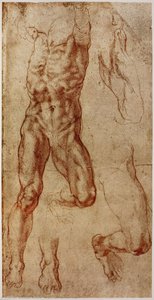
Michelangelo Buonarroti, a titan of the High Renaissance, possessed an unparalleled ability to distill human experience onto canvas and stone. Among his vast oeuvre, the drawing known as ‘Three Standing Men (recto)’ – currently residing within the esteemed Graphische Sammlung Albertina in Vienna – offers a poignant glimpse into this extraordinary talent. Executed with remarkable precision in pen on paper in 1494, this work transcends mere representation; it’s a study of posture, emotion, and the subtle language of the human form, revealing a profound depth rarely achieved in drawing.
The image presents three figures standing close together, each imbued with distinct gestures and expressions. The man on the left, his hands clasped before him in a gesture of contemplation or perhaps prayer, immediately draws the eye. Across from him, the second figure, seemingly gazing downwards, evokes a sense of introspection or melancholy. And finally, the third man, lost in distant thought, embodies a quiet solitude – a powerful depiction of individual experience within a shared space. These aren’t merely portraits; they are carefully constructed studies in human psychology, demonstrating Michelangelo's acute observation and his ability to capture fleeting moments of inner life.
‘Three Standing Men (recto)’ is a testament to Michelangelo’s mastery of the pen. The drawing showcases an astonishing level of detail, achieved through meticulous shading and line work. Notice how he renders the texture of clothing, the subtle contours of faces, and the weight of each figure's stance. The use of pen allows for incredible control – a delicate balance between precision and expressive fluidity. This particular medium was favored by Michelangelo during this period, offering him the versatility to create both detailed studies and preliminary sketches for larger works. The drawing’s monochrome palette further emphasizes the figures themselves, stripping away extraneous detail and focusing attention on their forms and expressions.
Created in 1494, ‘Three Standing Men (recto)’ exists within a pivotal moment of artistic innovation. The Renaissance was flourishing across Italy, fueled by renewed interest in classical antiquity and a burgeoning spirit of humanism. Michelangelo, deeply influenced by this era, sought to capture the essence of humanity – its beauty, its struggles, and its inherent complexity. The Graphische Sammlung Albertina, itself a treasure trove of prints and drawings, provides an invaluable context for appreciating this work. This institution’s collection represents centuries of artistic production, offering a comprehensive view of printmaking techniques and showcasing the works of masters like Michelangelo alongside contemporary artists.
While seemingly simple in composition, ‘Three Standing Men (recto)’ is rich with symbolic potential. The figures’ postures invite interpretation – are they engaged in a private conversation? Are they reflecting on their lives? Or perhaps they represent different facets of human nature itself? Michelangelo's genius lies not just in his technical skill but also in his ability to evoke emotion and stimulate the viewer's imagination. This drawing, like so many of his works, invites us to contemplate the mysteries of the human condition and the enduring power of art to capture our deepest thoughts and feelings. For those seeking a high-quality reproduction, Most-Famous-Paintings offers meticulously crafted reproductions that faithfully preserve the beauty and nuance of this remarkable masterpiece.


1475 - 1564 , Italy
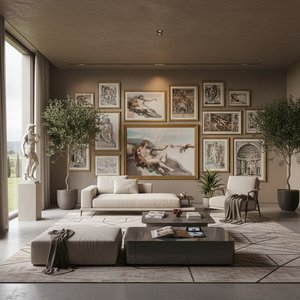
Journey through Michelangelo's 25 greatest artworks – from David’s strength to the Sistine Chapel’s beauty. Explore Renaissance masterpieces, art history & find museum-quality reproductions for your home at Most-Famous-Paintings.com.

Journey through the Uffizi Gallery's 25 most iconic Renaissance artworks! Explore Botticelli, Leonardo da Vinci & Michelangelo’s masterpieces. Find museum-quality art reproductions and curated decor ideas to bring timeless Italian beauty into your home. Discover all masterpieces on Most-Famous-Paintings.com
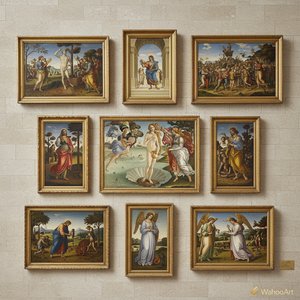
Journey through the Early Renaissance! Explore 10 iconic paintings by Botticelli, Leonardo da Vinci & Michelangelo. Discover their stories, techniques & lasting impact. Find museum-quality art reproductions and elevate your home decor with .

Journey through 25 iconic artworks at the Metropolitan Museum of Art! Explore Van Gogh, Monet, Rembrandt & more. Discover art history, inspiring stories, and museum-quality reproductions to elevate your home decor. Explore the full collection on Most-Famous-Paintings.com.

Explore 10 Renaissance Humanism masterpieces by Leonardo da Vinci, Michelangelo & Raphael. Discover the stories behind these iconic paintings & sculptures and bring timeless art into your home with museum-quality reproductions from Most-Famous-Paintings.com. Explore the full collection online!


Stay updated with the latest art news, exclusive offers, and decoration ideas.
Tell us about your project and our art experts will provide you with 3 personalized art suggestions.
Let Us Curate 3 Options Just for You - Free!


 Buy print
 Send
Send Share
Share
 Details

 Download
 Similars
 X-Ray
X-Ray Diaporama
 Read More







 Glass option is only available in size under 110 CM