x


Hand-painted oil on canvas in your size and frame, made to order by our artists.
Pick from our preset sizes that match the artwork's original proportions.

You may enter your own dimensions to fit a specific frame or space. If your selected size does not match the original image's proportions, we will either crop the artwork or extend the painting with additional hand-painted elements. A digital mockup will be sent for your approval before production begins.
Please note that the on-screen preview does not reflect the actual cropping or extension. Only the mockup will accurately show the final composition.
While custom sizes are available, we recommend selecting a dimension from the predefined list to preserve the original proportions.
Worldwide Delivery () in 3/4 weeks instead of standard 5 weeks. (18 July). No compromise on quality.


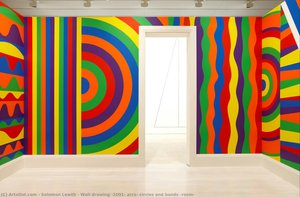
Vertical Lines, Not Touching
Reproduction Size
Solomon Lewitt's "Vertical Lines, Not Touching," created in 1970, isn’t merely a drawing; it’s an architectural meditation rendered in graphite on paper. This deceptively simple work embodies the core tenets of minimalism—a movement that sought to strip art down to its essential elements, prioritizing process and concept over ornamentation or representational imagery. The piece immediately commands attention not through vibrant color or dramatic form, but through a profound sense of order and contained energy. It’s an invitation to contemplate the beauty found within repetition and the quiet power of geometric precision.
At first glance, “Vertical Lines, Not Touching” presents a starkly minimalist composition: a square defined by a grid of closely spaced vertical lines. The meticulous execution is key to its impact; each line is drawn with deliberate control, creating a surface that subtly suggests texture through the density of its markings. The choice of monochromatic gray reinforces this sense of austerity and focuses attention entirely on the structure itself. Lewitt’s approach was deeply rooted in mathematics and geometry – disciplines he studied extensively early in his career – reflecting a belief that art could be understood and appreciated through rational, logical systems. The title, “Vertical Lines, Not Touching,” isn't just descriptive; it’s a statement of principle, highlighting the fundamental constraint upon which the entire piece is built.
Created during a pivotal moment in art history – the late 1960s and early 70s – “Vertical Lines, Not Touching” aligns perfectly with the burgeoning minimalist movement. Artists like Donald Judd and Carl Andre were pushing against traditional notions of sculpture, favoring industrial materials and geometric forms. However, Lewitt’s approach differed subtly; he often employed a ‘wall drawing’ technique, creating works that could be executed by multiple assistants simultaneously, emphasizing the collaborative nature of art-making and blurring the lines between artist and participant. This concept – the idea that the process itself is as important as the finished product – became central to Lewitt's practice and profoundly influenced subsequent generations of conceptual artists.
While seemingly devoid of overt symbolism, “Vertical Lines, Not Touching” invites a deeper interpretation. The strict grid evokes notions of order, control, and even confinement – perhaps reflecting the anxieties of a rapidly changing world. The repetition of the lines creates a hypnotic effect, drawing the viewer into a state of quiet contemplation. It’s a work that rewards patient observation, revealing subtle variations in tone and texture that suggest depth and complexity beneath its surface simplicity. The “not touching” aspect reinforces this sense of restraint, suggesting a deliberate avoidance of conflict or disruption – a powerful statement about harmony and balance.
Today, "Vertical Lines, Not Touching" remains a significant work in the canon of minimalist art. Its clean lines and understated elegance make it an ideal choice for contemporary interior design, adding a touch of sophisticated restraint to any space. High-quality reproductions capture the subtle nuances of Lewitt’s technique, allowing viewers to appreciate the meticulous detail that defines this iconic piece. When considering a reproduction, remember that the essence of the work lies not just in its visual appearance but also in the conceptual framework it represents – a testament to the power of simplicity and the enduring appeal of geometric abstraction.


1928 - 2007 , United States of America
Explore 10 iconic gray paintings by masters like Rembrandt, Hopper & Whistler. Discover the stories behind these atmospheric artworks and find museum-quality art reproductions for your home decor at . Explore the full collection online.

Find serenity with 10 minimalist masterpieces! Explore Agnes Martin, Rothko & more. Discover the stories behind iconic abstract art, neutral palettes & calming designs. Museum-quality reproductions at Most-Famous-Paintings.com – elevate your home decor today!

Journey into the surreal world of Max Ernst! Explore 25 iconic paintings, from Dada to abstract expressionism. Discover the stories behind his masterpieces & find museum-quality art reproductions for your home decor at Most-Famous-Paintings.com.

Elevate corporate relationships with thoughtful art gifts. Discover bespoke commissions, museum-quality reproductions & expert consultation for lasting impact. Most-Famous-Paintings – fostering connection through symbolic expression.

Elevate your corporate events with personalized artwork! Our art concierge service offers curated collections & bespoke commissions for lasting impressions. Expert guidance, secure delivery & legal compliance guaranteed.


Stay updated with the latest art news, exclusive offers, and decoration ideas.
Tell us about your project and our art experts will provide you with 3 personalized art suggestions.
Let Us Curate 3 Options Just for You - Free!


 Buy print
 Send
Send Share
Share
 Details

 Download
 Similars
 X-Ray
X-Ray Diaporama


 Read More




































 Glass option is only available in size under 110 CM