x


Hand-painted oil on canvas in your size and frame, made to order by our artists.
Pick from our preset sizes that match the artwork's original proportions.

You may enter your own dimensions to fit a specific frame or space. If your selected size does not match the original image's proportions, we will either crop the artwork or extend the painting with additional hand-painted elements. A digital mockup will be sent for your approval before production begins.
Please note that the on-screen preview does not reflect the actual cropping or extension. Only the mockup will accurately show the final composition.
While custom sizes are available, we recommend selecting a dimension from the predefined list to preserve the original proportions.
Worldwide Delivery () in 3/4 weeks instead of standard 5 weeks. (18 July). No compromise on quality.


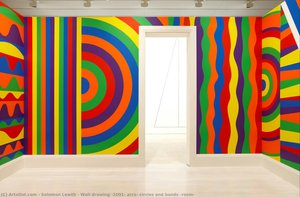
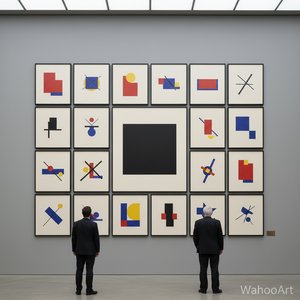
Wall Drawing #831
Reproduction Size
In the vast landscape of twentieth-century modernism, few names resonate with as much intellectual rigor as Solomon Lewitt. His Wall Drawing #831, created in 1997, serves as a breathtaking testament to the power of the idea over the hand. As a pioneer of both Minimalism and Conceptual Art, Lewitt famously posited that the concept itself is the machine that makes the art. This particular work is not merely a painting on a surface, but the physical manifestation of a pre-determined logical system. When one stands before this vibrant mural, they are witnessing the execution of a set of written instructions—a mathematical choreography that dictates how lines, colors, and shapes must interact within the architectural space.
The visual experience of Wall Drawing #im831 is nothing short of immersive. A kaleidoscope of primary and secondary hues—deep blues, fiery reds, lush greens, sunny yellows, warm oranges, and regal purples—intertwines to create a rhythmic, geometric tapestry. Unlike traditional landscapes or portraits that seek to mimic reality, this work seeks to construct a new reality through pure abstraction. The technique relies on the precision of geometric repetition, where each stroke follows a strict logic, yet the sheer scale and color density produce an organic, almost pulsating energy. For the observer, the eye is led on a journey through a labyrinth of color, discovering how simple rules can blossom into complex, mesmerizing patterns.
To understand the profound impact of this piece, one must look back to Lewitt’s formative years in Syracuse, where his fascination with mathematics and geometry began to take root. This analytical foundation allowed him to strip away the "ego" of the artist, replacing spontaneous emotion with a structured, systemic approach. In Wall Drawing #831, we see the culmination of this lifelong pursuit. The historical context of the late 20th century, a period marked by a move away from the gestural abstraction of previous decades, finds its perfect expression here. Lewitt’s work challenges the viewer to reconsider the very definition of authorship; if the artist provides the instructions and others execute them, where does the soul of the artwork reside? In this piece, it resides in the brilliance of the initial thought.
For collectors and interior designers, a high-quality reproduction of such a monumental work offers more than just decoration; it offers an intellectual centerpiece. The vibrant palette and structured composition make it an ideal choice for modern, minimalist, or contemporary spaces, providing a sense of movement and structural depth to any room. Whether placed in a grand gallery setting or a sophisticated private study, the piece invites contemplation and conversation. It is a window into a world where logic meets beauty, and where the boundaries between mathematics and art dissolve into a singular, breathtaking vision.


1928 - 2007 , United States of America
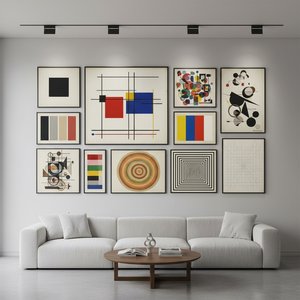
Explore 10 defining masterpieces of Geometric Abstraction! Discover Kandinsky, Mondrian & Malevich’s iconic works. Find museum-quality art reproductions and curated decor ideas to elevate your home at Most-Famous-Paintings.com.
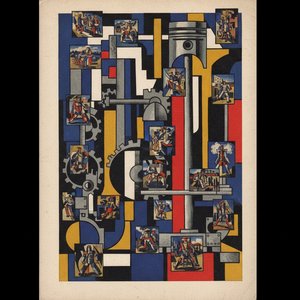
Explore 25 iconic Fernand Léger paintings that defined the Machine Age & Cubism. Discover the stories behind his bold colors, geometric forms & avant-garde style. Find museum-quality art reproductions on Most-Famous-Paintings.com.
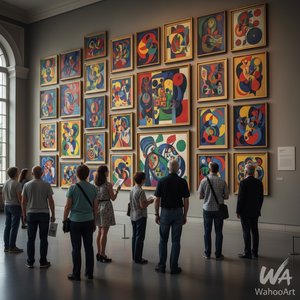
Journey through Wassily Kandinsky's 25 most iconic abstract paintings. Explore his revolutionary use of color, form & spiritual expressionism. Find museum-quality Kandinsky reproductions and elevate your home decor with Most-Famous-Paintings.com. Discover all masterpieces on Most-Famous-Paintings.com!
Explore 25 iconic artworks by Kazimir Malevich, pioneer of Suprematism & abstract art. Discover the stories behind 'Black Square' and more! Find museum-quality prints & elevate your home decor with Most-Famous-Paintings.com.

Journey through 25 iconic artworks at the Metropolitan Museum of Art! Explore Van Gogh, Monet, Rembrandt & more. Discover art history, inspiring stories, and museum-quality reproductions to elevate your home decor. Explore the full collection on Most-Famous-Paintings.com.


Stay updated with the latest art news, exclusive offers, and decoration ideas.
Tell us about your project and our art experts will provide you with 3 personalized art suggestions.
Let Us Curate 3 Options Just for You - Free!


 Buy print
 Send
Send Share
Share
 Details

 Download
 Similars
 X-Ray
X-Ray Diaporama


 Read More




































 Glass option is only available in size under 110 CM