




The Rise of Boldini: From Florentine Beginnings to Parisian Star
 Wikipedia: Giovanni Boldini
Giovanni Boldini (31 December 1842 – 11 January 1931) was an Italian genre and portrait painter who lived and worked in Paris for most of his career. According to a 1933 article in Time magazine, he was known as the "Master of Swish" because of his f...
Giovanni Boldini’s name evokes a specific era – the glittering, decadent world of Belle Époque Paris. Yet, his journey began far from the boulevards and salons that would ultimately define him. Born in Ferrara, Italy, in 1842, Boldini inherited a painter's hand from his father, but it was Florence that first ignited his artistic ambition. While he briefly attended the Academy of Fine Arts, his true education unfolded amidst the burgeoning realist movement known as the Macchiaioli – Italian precursors to Impressionism. This early exposure instilled in him a spontaneity and responsiveness to light that would later characterize his work, though his path diverged from strict academic adherence. A sojourn to London proved formative, exposing him to the portraiture of Gainsborough and the wit of English caricaturists, elements that subtly infused his developing style. However, it was Paris – arriving in 1867 and settling permanently after a brief return – where Boldini truly blossomed, becoming not merely *a* painter of society, but its visual chronicler.
Boldini’s Signature Style: ‘Swish,’ Dynamism, and the Pursuit of Elegance
 A Midsummer Night's Dream
Experience the elegance of Giovanni Boldini's 'A Midsummer Night's Dream.' This Impressionist masterpiece captures a graceful scene with dynamic brushwork and Parisian charm – a timeless portrait.
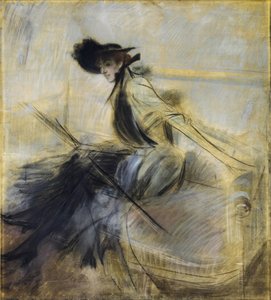
To describe Boldini's technique is to invoke a sense of movement. He earned the moniker “Master of Swish” – a testament to the flowing lines, energetic brushwork, and seemingly effortless grace that define his paintings. This wasn’t simply about technical skill; it was an attempt to capture not just likeness, but *essence*. His portraits aren't static representations; they convey a sense of fleeting moments, of women caught mid-gesture, dresses rustling with implied motion. He layered paint with remarkable dexterity, creating textures that shimmer and breathe. The influence of the Macchiaioli is visible in his use of color – vibrant, often unexpected combinations that capture the play of light on silk, skin, and jewels. But Boldini wasn’t merely an imitator; he synthesized these influences into a uniquely personal style, one that prioritized elegance, sophistication, and a palpable sense of vitality. He sought to portray not just *what* his subjects looked like, but how they felt – their confidence, their allure, their inner lives.
Capturing Society: The Aristocracy, Actresses, and Celebrities of Belle Époque Paris
"Fin de siècle" (French: [fɛ̃ də sjɛkl] ) is a French term meaning 'end of century', a phrase which typically encompasses both the meaning of the similar English idiom turn of the century and also makes reference to the closing of one era and onset o...
Boldini’s ascent coincided with the peak of Parisian society. He became the painter of choice for the aristocracy, the demi-monde, and the rising stars of the stage. His canvases are populated with faces that defined the era – women whose beauty and style set the tone for a generation. He didn't simply paint portraits; he *created* images, carefully curating his subjects’ appearance to enhance their allure. He advised on fabrics, jewelry, even posture, transforming them into idealized versions of themselves. This collaborative process cemented his position as not just an artist, but a tastemaker. The women who sat for Boldini weren't merely clients; they were partners in constructing a carefully crafted public persona. His studio became a hub of social activity, a place where ambition and artistry intertwined. He understood the power of image, and he wielded his brush with a keen awareness of its ability to shape perception.
The 'Miss Bell' Phenomenon & Boldini's Mastery of Portraiture
 miss bell
Admire Giovanni Boldini’s ‘Miss Bell’ (1903), a captivating portrait of a Parisian woman in red. Explore this elegant Impressionist masterpiece & its timeless beauty.
‘Miss Bell’ (1903), perhaps his most iconic work, exemplifies Boldini’s mastery. The painting depicts a Parisian woman in a striking red dress, her gaze direct and captivating. It isn’t simply the beauty of the subject that draws the eye; it's the *way* she is portrayed – poised, confident, radiating an almost palpable energy. The vibrant color palette, the dynamic brushwork, and the subtle details all contribute to a sense of immediacy and vitality. Miss Bell isn’t just a portrait; it’s a statement about femininity, modernity, and the power of self-presentation. The painting captures the spirit of the Belle Époque – its optimism, its extravagance, and its underlying current of sensuality. It's a testament to Boldini’s ability to not merely record his subjects, but to elevate them into symbols of their time.
Boldini and Sargent: A Study in Contrasts and Artistic Rivalry
 john singer sargent
Giovanni Boldini's 'John Singer Sargent' (1890) captures the artist's confident style & sophistication. A stunning handmade oil painting reproduction available now!
Inevitably, comparisons are drawn between Giovanni Boldini and John Singer Sargent – two titans of portraiture who dominated the late 19th-century art world. Both artists possessed a remarkable ability to capture likeness and convey personality. However, their approaches differed significantly. Sargent’s style was characterized by a more restrained elegance, a focus on psychological depth, and a masterful use of light and shadow. Boldini, in contrast, prioritized dynamism, vibrancy, and a sense of immediate impression. While Sargent often sought to reveal the inner lives of his subjects, Boldini focused on projecting an idealized image – one that emphasized beauty, confidence, and social status. Their relationship was complex, marked by both admiration and rivalry. ‘John Singer Sargent’ (1890), Boldini's portrait of his contemporary, reveals a nuanced understanding of Sargent’s character – a sense of intellectualism tempered with a hint of aloofness. The painting is not merely a likeness; it’s an artistic statement about the nature of portraiture itself.
Legacy and Influence: Boldini’s Enduring Appeal in the Modern Era
Though briefly dismissed by some as a painter of “champagne dinners and lace blouses,” Boldini's work has experienced a remarkable resurgence in recent decades. His paintings are now celebrated for their technical brilliance, their historical significance, and their enduring appeal. He captured an era – the Belle Époque – with unparalleled skill and sensitivity, creating images that continue to captivate audiences today. His influence can be seen in countless artists who followed, particularly those drawn to portraiture and the depiction of elegance and sophistication. Boldini’s legacy isn't simply about his paintings; it’s about his ability to capture the spirit of a time – its beauty, its extravagance, and its underlying sense of optimism. At Most-Famous-Paintings.com, we are proud to offer high-quality reproductions of Boldini's masterpieces, allowing you to bring the elegance of Belle Époque Paris into your own home.





