x


Hand-painted oil on canvas in your size and frame, made to order by our artists.





























Pick from our preset sizes that match the artwork's original proportions.

You may enter your own dimensions to fit a specific frame or space. If your selected size does not match the original image's proportions, we will either crop the artwork or extend the painting with additional hand-painted elements. A digital mockup will be sent for your approval before production begins.
Please note that the on-screen preview does not reflect the actual cropping or extension. Only the mockup will accurately show the final composition.
While custom sizes are available, we recommend selecting a dimension from the predefined list to preserve the original proportions.
Worldwide Delivery () in 3/4 weeks instead of standard 5 weeks. (18 July). No compromise on quality.


Head of a Woman. Gerda
Reproduction Size
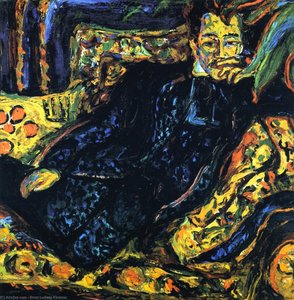
Ernst Ludwig Kirchner's “Head of a Woman. Gerda,” a compelling study in emotional intensity, offers a window into the turbulent heart of early 20th-century German Expressionism. Painted around 1914, this work transcends a simple portrait; it becomes a visceral exploration of isolation, melancholy, and the anxieties simmering beneath the surface of modern life. Kirchner, a founding member of “Die Brücke” (The Bridge), wasn’t interested in replicating reality – he sought to capture its emotional truth, often through distorted forms and jarring color palettes. This piece exemplifies that approach perfectly, inviting viewers into a world where feeling reigns supreme over precise representation.
The composition is deceptively simple: the woman's head and upper torso dominate the canvas, framed against a deliberately blurred background. This strategic cropping immediately draws attention to her face – an enigmatic mask of quiet contemplation. Kirchner masterfully employs a diagonal emphasis, subtly guiding the eye through the arrangement of shapes and lines, creating a sense of movement and tension within the confined space. The directness of her gaze is particularly striking; she confronts the viewer with an unspoken question, a silent plea for understanding or perhaps simply a reflection of our own inner turmoil.
Kirchner's palette in “Head of a Woman. Gerda” is both arresting and deeply evocative. Dominating the scene are bold reds, yellows, blacks, and muted greens and grays – colors deliberately chosen to amplify the emotional impact. The vibrant red of her jacket acts as a focal point, demanding attention while simultaneously hinting at passion or perhaps even danger. Strategic yellow highlights suggest fleeting moments of light, adding depth and volume to the figure’s features, while the pervasive black outlines define her form with sharp precision. The use of lines is equally crucial; they are not clean or realistic but rather jagged, angular, and expressive – a hallmark of Expressionist technique. These lines don't simply delineate shapes; they actively contribute to the overall feeling of unease and psychological intensity.
Technically, Kirchner utilizes an impasto application of paint, building up thick layers of color with visible brushstrokes. This textured surface isn’t merely decorative; it adds a tactile quality to the work, inviting viewers to engage with the painting on a physical level. The deliberate roughness and physicality of the paint further emphasize the emotional urgency conveyed by the image – as if the artist himself was wrestling with his own inner demons.
Beyond its formal elements, “Head of a Woman. Gerda” is rich in symbolic meaning. The woman’s expression—a subtle blend of melancholy and introspection—suggests a profound awareness of her own isolation within the rapidly changing world. The blurred background reinforces this sense of detachment, implying a separation from society or perhaps even from herself. Some art historians interpret the red jacket as representing suppressed passion or defiance, while the muted greens and grays could symbolize the anxieties and uncertainties of the era. The flower adorning her hat adds a touch of fragile beauty to the otherwise stark composition, hinting at a yearning for connection amidst the prevailing sense of alienation.
Kirchner’s work reflects the broader social and political climate of early 20th-century Germany – a period marked by rapid industrialization, urbanization, and growing social unrest. “Head of a Woman. Gerda” serves as a poignant reminder of the psychological toll exacted by these forces, capturing the anxieties and uncertainties that characterized this transformative era. It’s a powerful testament to Kirchner's ability to translate complex emotions into a visually arresting and emotionally resonant work of art.
For high-quality reproductions and prints of ‘Head of a Woman. Gerda,’ please visit Most-Famous-Paintings.com


1880 - 1938 , Germany

Explore the rich symbolism of the red dress in art history! From ancient power displays to iconic portraits like Cézanne’s 'Madame Cezanne', discover the cultural and artistic significance behind this captivating color. Expert analysis & insights.

Explore 10 legendary 'Acrylic On Canvas' masterpieces by artists like Rothko, Warhol & Frankenthaler. Discover the stories behind these iconic paintings and their impact on modern art. Find museum-quality reproductions at – elevate your home with timeless beauty.

Explore the captivating world of Raphael Kirchner, a master of Art Nouveau illustration during the Belle Époque. Discover his iconic 'Kirchner Girls,' pioneering pin-up art & lasting influence.

Explore 10 iconic paintings where cadmium green reigns supreme! From Monet to Van Gogh, discover the stories behind these masterpieces & the power of color. Find museum-quality art reproductions and elevate your home decor on .

Explore 25 iconic Mark Rothko paintings that define Abstract Expressionism. Discover the stories, colors & emotions behind these masterpieces. Find museum-quality art reproductions and curated decor ideas at Most-Famous-Paintings.com.


Stay updated with the latest art news, exclusive offers, and decoration ideas.
Tell us about your project and our art experts will provide you with 3 personalized art suggestions.
Let Us Curate 3 Options Just for You - Free!


 Buy print
 Send
Send Share
Share
 Details

 Download
 Similars
 X-Ray
X-Ray Diaporama
 Read More







 Glass option is only available in size under 110 CM