x

Hand-painted oil on canvas in your size and frame, made to order by our artists.





























Pick from our preset sizes that match the artwork's original proportions.

You may enter your own dimensions to fit a specific frame or space. If your selected size does not match the original image's proportions, we will either crop the artwork or extend the painting with additional hand-painted elements. A digital mockup will be sent for your approval before production begins.
Please note that the on-screen preview does not reflect the actual cropping or extension. Only the mockup will accurately show the final composition.
While custom sizes are available, we recommend selecting a dimension from the predefined list to preserve the original proportions.
Worldwide Delivery () in 3/4 weeks instead of standard 5 weeks. (18 July). No compromise on quality.


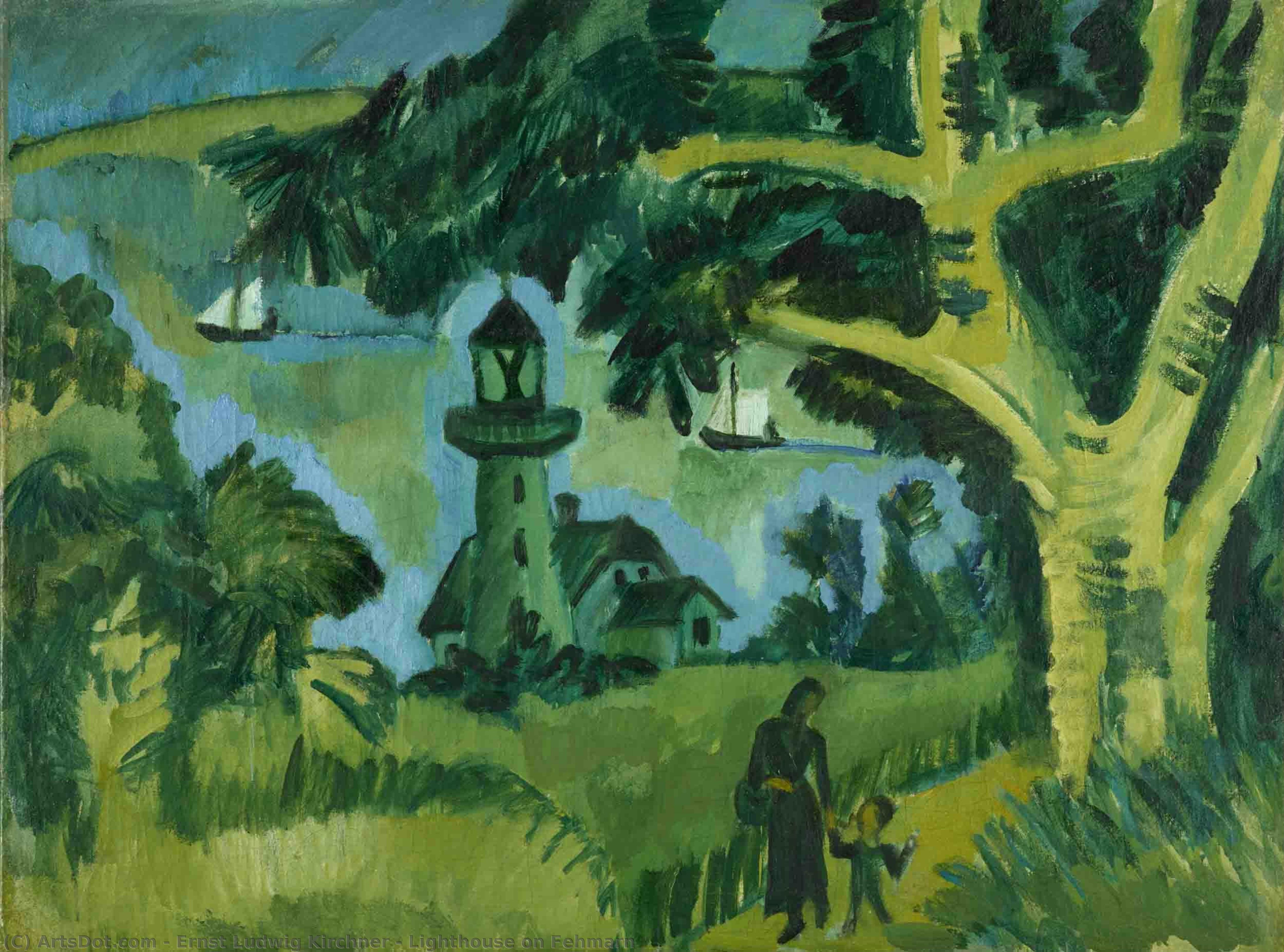
Lighthouse on Fehmarn
Reproduction Size
Ernst Ludwig Kirchner's "Lighthouse on Fehmarn," painted in 1912, isn’t merely a depiction of a coastal landmark; it’s a carefully constructed tableau of memory, melancholy, and the quiet yearning for stability amidst the turbulent currents of early 20th-century Germany. Kirchner, a pivotal figure within the Expressionist movement, wasn't interested in simply recording a scene; he sought to distill feeling, to translate the emotional landscape onto canvas with an intensity rarely seen before. This particular work offers a poignant glimpse into his personal journey – a retreat to the island of Fehmarn, a place that would soon become inextricably linked with both solace and the looming anxieties of a world on the brink.
The painting immediately draws the eye to the lighthouse itself, a robust sentinel rising from the rolling Baltic waters. Kirchner’s technique is deliberately rough-hewn, employing bold, visible brushstrokes that convey a sense of immediacy and unrest. The ochre and green hues of the landscape – the weathered cliffs, the dense foliage clinging to the shoreline – are applied with an almost frantic energy, suggesting both the beauty and the inherent wildness of the environment. The water, rendered in shimmering blues and greens, isn’t a serene reflection but rather a dynamic force, subtly hinting at the power beneath the surface. The arched horizon line, a key element of Kirchner's style, serves to compress the space, drawing the viewer into the scene and intensifying the feeling of being enveloped by the landscape.
Dominating the foreground is a woman, clad in dark clothing, her posture suggesting a contemplative walk. While her identity remains somewhat ambiguous – often interpreted as Kirchner’s companion, Erna Schilling – she embodies a crucial shift within the artist's life. Having recently departed from the vibrant, chaotic energy of Berlin, Kirchner sought refuge on Fehmarn, a deliberate move away from the city’s relentless pace and the emotional complexities he had experienced there. The woman’s presence isn’t one of active engagement; rather, she represents a quiet acceptance, a step towards a more subdued existence – a stark contrast to the passionate, often turbulent relationships depicted in his earlier Berlin works. Her hand outstretched, grasping that of a child, subtly evokes themes of protection and legacy, hinting at Kirchner's desire for stability and perhaps even a new beginning.
Kirchner’s use of color is profoundly symbolic. The dark clothing of the woman contrasts sharply with the brighter tones of the landscape, creating a visual tension that mirrors the emotional shift occurring within Kirchner himself. The small sailboats dotting the horizon represent fleeting moments of pleasure amidst an underlying sense of unease – a reminder of the world beyond Fehmarn, yet one he’s consciously choosing to distance himself from. The lighthouse, traditionally a symbol of guidance and safety, here takes on a slightly melancholic quality; it stands as a solitary beacon in a vast, uncertain expanse, reflecting Kirchner's own feelings of isolation and introspection. The painting is not simply about depicting a physical location but rather conveying the complex emotional state of an artist grappling with personal change.
Reproductions of “Lighthouse on Fehmarn” offer a remarkable opportunity to experience Kirchner’s evocative style firsthand. The meticulous detail captured in each brushstroke, the raw emotional intensity conveyed through color and composition – these elements are faithfully reproduced in high-quality prints, allowing art lovers and collectors alike to appreciate the depth and complexity of this iconic work. Beyond its aesthetic appeal, “Lighthouse on Fehmarn” serves as a powerful reminder of Kirchner’s artistic journey—a testament to his ability to transform personal experience into enduring works of art that continue to resonate with viewers today. It's a piece that invites contemplation, prompting us to consider the interplay between memory, emotion, and the search for meaning in a rapidly changing world.


1880 - 1938 , Germany

Journey through 25 iconic Claude Monet masterpieces! Explore Impressionism’s beauty, from Water Lilies to Rouen Cathedral. Discover stunning art reproductions & curated decor ideas – explore the full collection online at Most-Famous-Paintings.com.
Explore 10 iconic gray paintings by masters like Rembrandt, Hopper & Whistler. Discover the stories behind these atmospheric artworks and find museum-quality art reproductions for your home decor at . Explore the full collection online.
Explore 25 iconic Mark Rothko paintings that define Abstract Expressionism. Discover the stories, colors & emotions behind these masterpieces. Find museum-quality art reproductions and curated decor ideas at Most-Famous-Paintings.com.

Dive into serenity with 10 famous paintings bathed in calming medium sea green. Explore Impressionist masterpieces by Monet, Degas & Renoir. Find museum-quality art reproductions and elevate your home decor at Most-Famous-Paintings.com.

Explore 10 famous paintings where 'Chrome Green' reigns supreme! Discover Monet, Manet & Van Gogh’s masterpieces. Learn the stories behind these iconic artworks and find museum-quality art reproductions for your home at .


Stay updated with the latest art news, exclusive offers, and decoration ideas.
Tell us about your project and our art experts will provide you with 3 personalized art suggestions.
Let Us Curate 3 Options Just for You - Free!


 Buy print
 Send
Send Share
Share
 Details

 Download
 Similars
 X-Ray
X-Ray Diaporama

 Read More







 Glass option is only available in size under 110 CM