x


 Oil On CanvasWallArtGerman Expressionism
 1910Modern
 64.0 x 91.0 cm
Hand-painted oil on canvas in your size and frame, made to order by our artists.





























Pick from our preset sizes that match the artwork's original proportions.

You may enter your own dimensions to fit a specific frame or space. If your selected size does not match the original image's proportions, we will either crop the artwork or extend the painting with additional hand-painted elements. A digital mockup will be sent for your approval before production begins.
Please note that the on-screen preview does not reflect the actual cropping or extension. Only the mockup will accurately show the final composition.
While custom sizes are available, we recommend selecting a dimension from the predefined list to preserve the original proportions.
Worldwide Delivery () in 3/4 weeks instead of standard 5 weeks. (18 July). No compromise on quality.


Villa in Dresden
Reproduction Size
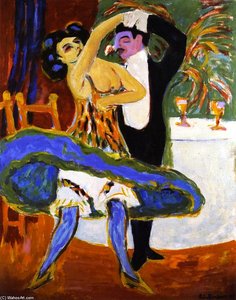
To stand before Ernst Ludwig Kirchner's depiction of a villa in Dresden is to step directly into the charged atmosphere of early 20th-century German life. This painting, executed around 1910, is far more than a mere architectural portrait; it is a vibrant emotional snapshot. The composition centers on a magnificent structure, characterized by its striking red roofs and deep blue walls—a palette that immediately arrests the eye with its bold, almost feverish energy. The house itself seems to pulse with color, embodying the burgeoning modernity of the era while simultaneously hinting at an underlying tension.
The figures meandering through the scene are not simply passersby; they are participants in a moment captured by Kirchner’s restless vision. They move past the imposing facade, their presence adding a human scale to the grand architecture and suggesting narratives unfolding just beyond the canvas's edge. It is an invitation to the viewer to imagine themselves within that very moment of observation.
Kirchner was a pioneer whose brushstrokes refused the polished veneer of academic tradition. Here, his signature style—German Expressionism—shines through with breathtaking force. The technique employed is characterized by bold outlines and saturated, unblended color fields. Notice how the forms are not rendered with photographic precision but rather with an emotional resonance. The geometry of the villa is simplified, its colors heightened, allowing the underlying feeling—the energy, the excitement, perhaps even the anxiety—to take precedence over mere realistic depiction.
For those who appreciate art that speaks directly to the soul, this piece offers a masterclass in color theory applied emotionally. The juxtaposition of the cool blues against the warm reds creates a visual vibration, making the entire canvas feel alive, as if the paint itself is humming with latent energy.
Understanding the context of 1910 is crucial to appreciating the depth of this work. This period was one of immense cultural ferment in Germany—a time of rapid industrialization, social change, and mounting geopolitical tension. Kirchner and his contemporaries were reacting against the perceived superficiality of bourgeois society. Their art became a raw conduit for inner experience rather than outer observation. The villa, therefore, can be read not just as a beautiful dwelling, but perhaps as a symbol of established order being viewed through the lens of modern unease.
This painting captures that exquisite tension: the allure of grand civilization set against the palpable energy of individual existence navigating change. It speaks to the spirit of an age poised between opulent certainty and profound uncertainty.
Whether you are curating a gallery wall or seeking a singular piece to anchor a richly decorated interior, this reproduction offers unparalleled depth. The scale (64 x 91 cm) allows the drama of the composition to unfold beautifully in any setting. Owning a piece like this is not simply acquiring art; it is incorporating a piece of expressive history into your daily life. It demands attention, sparks conversation, and reminds the viewer that the most beautiful structures—be they buildings or lives—are always imbued with vibrant, untamed emotion.


1880 - 1938 , Germany

Journey through 25 iconic artworks at the Metropolitan Museum of Art! Explore Van Gogh, Monet, Rembrandt & more. Discover art history, inspiring stories, and museum-quality reproductions to elevate your home decor. Explore the full collection on Most-Famous-Paintings.com.
Explore 10 defining German Expressionism masterpieces – from Munch's 'The Scream' to Kandinsky’s abstracts. Discover the artists, stories & bold colors behind this powerful art movement. Find museum-quality reproductions at Most-Famous-Paintings.com.
Delve into the haunting world of Egon Schiele with our curated selection of his 25 most iconic Expressionist paintings. Explore the artist's life, technique & emotional depth. Find museum-quality Schiele reproductions and elevate your home decor on Most-Famous-Paintings.com.

Explore 25 iconic artworks from Washington DC's National Gallery of Art! Discover masterpieces by Cézanne, Matisse & Picasso. Find museum-quality art reproductions and elevate your home decor with timeless paintings. Explore the full collection online at Most-Famous-Paintings.com.
Journey through 25 iconic James Abbott McNeill Whistler paintings! Explore his masterpieces of Aestheticism, from 'Nocturne in Black and Gold' to captivating portraits. Find museum-quality art reproductions & elevate your home decor with Most-Famous-Paintings.com. Discover the full collection online.


Stay updated with the latest art news, exclusive offers, and decoration ideas.
Tell us about your project and our art experts will provide you with 3 personalized art suggestions.
Let Us Curate 3 Options Just for You - Free!


 Buy print
 Send
Send Share
Share
 Details

 Download
 Similars
 X-Ray
X-Ray Diaporama
 Read More







 Glass option is only available in size under 110 CM