x


 Acrylic On CanvasWallArtImpressionist Painting
 1875
1875 45.0 x 37.0 cm
 Sterling and Francine Clark Art Institute
Hand-painted oil on canvas in your size and frame, made to order by our artists.





























Pick from our preset sizes that match the artwork's original proportions.

You may enter your own dimensions to fit a specific frame or space. If your selected size does not match the original image's proportions, we will either crop the artwork or extend the painting with additional hand-painted elements. A digital mockup will be sent for your approval before production begins.
Please note that the on-screen preview does not reflect the actual cropping or extension. Only the mockup will accurately show the final composition.
While custom sizes are available, we recommend selecting a dimension from the predefined list to preserve the original proportions.
Worldwide Delivery () in 3/4 weeks instead of standard 5 weeks. (18 July). No compromise on quality.


Crossing the Street
Reproduction Size
Giovanni Boldini’s *Crossing the Street*, painted between 1873 and 1875, stands as an emblem of Impressionist art—a snapshot of bustling Parisian life captured with remarkable immediacy. Housed at the Sterling and Francine Clark Art Institute in Williamstown, Massachusetts, this oil on panel measuring 18 1/4 x 14 7/8 inches (46.2 x 37.8 cm) transcends mere depiction; it embodies a moment of urban dynamism infused with subtle psychological observation.
Boldini’s compositional strategy prioritizes movement, mirroring the frenetic pace of Parisian streets during the Belle Époque. The eye is drawn into a scene populated by figures traversing the cobblestones in various directions—a horse-drawn carriage gliding past, pedestrians hurrying along, and a delivery man navigating the crowded thoroughfare. Central to this dynamic arrangement is an elegantly dressed woman carrying a lavish bouquet of pink flowers; she dominates the foreground, her gaze fixed ahead with quiet determination.
Boldini’s masterful technique exemplifies Impressionist principles. Loose, visible brushstrokes—a hallmark of his style—create a palpable sense of energy and atmosphere. The artist eschews meticulous detail in favor of capturing the fleeting effects of light and color, applying paint thickly (impasto) to imbue surfaces with texture and depth. Notice how Boldini renders the woman’s dress and flowers with jewel-like hues – shades of emerald green, dusky rose, and lemon yellow—suggesting that these colors were applied swiftly before the viewer's eye registered them.
*Crossing the Street* is more than just a picturesque urban scene; it speaks to the social currents of its time. The woman’s solitary presence—despite the surrounding activity—radiates confidence and independence, reflecting a burgeoning trend toward female autonomy within Parisian society during the late 19th century. Boldini subtly conveys this notion through her posture and gaze, inviting contemplation on themes of femininity and societal expectations.
Furthermore, the inclusion of the bouquet of pink flowers adds another layer of symbolic significance. Traditionally associated with beauty, grace, and affection, these blossoms serve as a visual counterpoint to the woman’s seriousness, hinting at an inner life rich in emotion and aspiration. Boldini's careful attention to detail—the way the light catches on the petals—underscores his commitment to capturing not only what is seen but also what feels.
Giovanni Boldini’s *Crossing the Street* remains a cornerstone of Impressionist art history. Its influence can be discerned in subsequent generations of painters who sought to emulate Boldini's ability to convey atmosphere and emotion through luminous color palettes and expressive brushwork. Like other notable works by Boldini, such as *The Two Children*, this painting exemplifies Boldini’s dedication to portraying the human experience with sensitivity and artistic vision.
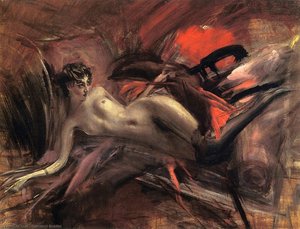
Considered alongside Boldini’s other portraits—particularly *Reclining Nude*—*Crossing the Street* solidifies his reputation as a master of capturing psychological nuance within seemingly simple compositions. It serves as a testament to Boldini's enduring legacy as one of the most celebrated Impressionist painters of his era.


1842 - 1931 , Italy

Journey through 25 iconic artworks at the Metropolitan Museum of Art! Explore Van Gogh, Monet, Rembrandt & more. Discover art history, inspiring stories, and museum-quality reproductions to elevate your home decor. Explore the full collection on Most-Famous-Paintings.com.
Explore 25 iconic artworks from Washington DC's National Gallery of Art! Discover masterpieces by Cézanne, Matisse & Picasso. Find museum-quality art reproductions and elevate your home decor with timeless paintings. Explore the full collection online at Most-Famous-Paintings.com.

Journey through 25 iconic artworks at the Detroit Institute of Arts! Explore Van Gogh, Monet, Rembrandt & more. Discover art history, stunning techniques & find museum-quality reproductions to elevate your home decor on Most-Famous-Paintings.com.

Explore the evolution of street art from rebellious origins to a respected fine art form. Discover key artists like Banksy & learn how to collect urban art with confidence. Expert insights for discerning investors.
Journey through 25 iconic James Abbott McNeill Whistler paintings! Explore his masterpieces of Aestheticism, from 'Nocturne in Black and Gold' to captivating portraits. Find museum-quality art reproductions & elevate your home decor with Most-Famous-Paintings.com. Discover the full collection online.


Stay updated with the latest art news, exclusive offers, and decoration ideas.
Tell us about your project and our art experts will provide you with 3 personalized art suggestions.
Let Us Curate 3 Options Just for You - Free!


 Buy print
 Send
Send Share
Share
 Details

 Download
 Similars
 X-Ray
X-Ray Diaporama
 Read More







 Glass option is only available in size under 110 CM