x


 Acrylic On CanvasWallArtFauvism
 1911Modern
 52.0 x 51.0 cm
Hand-painted oil on canvas in your size and frame, made to order by our artists.





























Pick from our preset sizes that match the artwork's original proportions.

You may enter your own dimensions to fit a specific frame or space. If your selected size does not match the original image's proportions, we will either crop the artwork or extend the painting with additional hand-painted elements. A digital mockup will be sent for your approval before production begins.
Please note that the on-screen preview does not reflect the actual cropping or extension. Only the mockup will accurately show the final composition.
While custom sizes are available, we recommend selecting a dimension from the predefined list to preserve the original proportions.
Worldwide Delivery () in 3/4 weeks instead of standard 5 weeks. (18 July). No compromise on quality.


Still Life
Reproduction Size
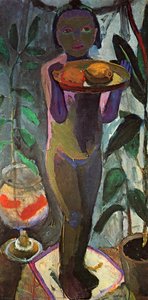
Kazimir Malevich's Still Life, painted in 1911, is more than a depiction of fruit arranged on a table; it represents a pivotal moment in the artist’s journey toward pure abstraction and a fascinating intersection of artistic influences. Measuring 52 x 51 cm, this work offers a glimpse into Malevich's early explorations beyond traditional representation, hinting at the radical innovations that would soon define his Suprematist style. The painting presents a familiar scene – apples, oranges, pears, plums, and bananas scattered across a surface against a backdrop of verdant greenery – yet it’s rendered with a boldness and simplification that sets it apart from conventional still lifes of the period.
Born in Kyiv Oblast, Ukraine, to a Polish family, Malevich absorbed the vibrant colors and patterns of Ukrainian folk art during his formative years. This early exposure instilled within him an appreciation for artistic expression that would subtly inform his later work. However, he quickly sought broader horizons, moving towards Moscow and eventually engaging with the burgeoning avant-garde movements sweeping across Europe. Still Life exemplifies this transitional phase. While clearly rooted in observation, it demonstrates a clear departure from Impressionism’s delicate rendering of light and atmosphere. Instead, Malevich embraces the heightened color palette and simplified forms characteristic of Fauvism – a style he encountered during a transformative trip to Paris in 1912. The painting's strong outlines and flat planes of color are reminiscent of artists like Henri Matisse, yet Malevich infuses the composition with a uniquely Russian sensibility.
The power of this work lies not just in its aesthetic qualities but also in what it foreshadows. Malevich wasn’t merely interested in replicating reality; he was actively deconstructing it, reducing objects to their essential geometric forms. The fruit isn't rendered with meticulous detail; rather, each piece is defined by bold contours and saturated hues. This process of simplification—of stripping away the superfluous—was a crucial step towards his ultimate goal: achieving “pure feeling” through non-objective art. Still Life can be seen as a laboratory where Malevich experimented with these ideas, testing the boundaries between representation and abstraction. It’s a quiet revolution unfolding on canvas, a prelude to the iconic Black Square that would shatter artistic conventions just a few years later.
Beyond its historical significance, Malevich's Still Life possesses an enduring aesthetic appeal. Its vibrant colors and simplified forms make it a compelling addition to any modern interior. The painting’s energy is both calming and invigorating—the lush greenery providing a sense of freshness while the bold fruit shapes add visual interest. A high-quality reproduction captures not only the artwork's beauty but also its intellectual depth, offering a conversation starter and a testament to the power of abstract thought. For collectors and designers alike, this piece represents an opportunity to own a fragment of art history—a work that embodies the spirit of innovation and the enduring quest for artistic purity.


1878 - 1935 , Ukraine
Explore 25 iconic artworks by Kazimir Malevich, pioneer of Suprematism & abstract art. Discover the stories behind 'Black Square' and more! Find museum-quality prints & elevate your home decor with Most-Famous-Paintings.com.

Explore the history of still life painting & discover how artful reproductions elevate villa entertaining spaces. Expert guidance, museum-quality prints & custom artwork at Most-Famous-Paintings.com.

Explore the rich history of still life painting with Most-Famous-Paintings. Discover Dutch Masters, decode vanitas symbolism & learn about collecting timeless art. Expert insights and museum-quality reproductions.
Explore 10 defining masterpieces of Geometric Abstraction! Discover Kandinsky, Mondrian & Malevich’s iconic works. Find museum-quality art reproductions and curated decor ideas to elevate your home at Most-Famous-Paintings.com.

Explore the revolutionary art of Kazimir Malevich & his groundbreaking Suprematism movement. Discover the origins, core principles, and lasting impact of this pivotal force in modern abstract painting.


Stay updated with the latest art news, exclusive offers, and decoration ideas.
Tell us about your project and our art experts will provide you with 3 personalized art suggestions.
Let Us Curate 3 Options Just for You - Free!


 Buy print
 Send
Send Share
Share
 Details

 Download
 Similars
 X-Ray
X-Ray Diaporama
 Read More







 Glass option is only available in size under 110 CM