Wishlist Shopping Cart Cart
Buy print Buy printBuy Image Buy Image SendSend
DetailsDetails Add to favorites Add to favorites DownloadDownload SimilarsSimilars X-RayX-Ray DiaporamaDiaporama

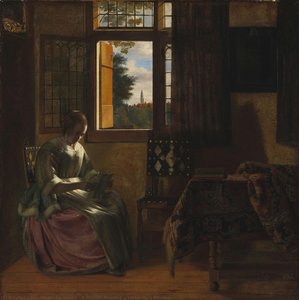
A Woman Reading a Letter by a Window

Pieter de Hooch’s "A Woman Reading a Letter" (1664) captures serene Dutch Golden Age domesticity. Admire the light, detail & intimate portrayal of a woman lost in thought by a window – a timeless masterpiece.

Pieter de Hooch (1629-1694) was a Dutch Golden Age painter known for his luminous depictions of domestic life, architectural interiors & tranquil courtyards. Explore his realistic style and influence on Impressionism.

Hand Made Oil Reproduction

Hand-painted oil on canvas in your size and frame, made to order by our artists.

P118B $10
P118H $10
P118W $10
P438Z $10
P508JH $12
P508YH $12
P805H $10
P805Z $10
P919BZ $10
P919G $10
P919XJ $10
P959ZH $10
P968JZ $12
W106C $8
W218G $10
W218JH $8
W218Y $10
W307PJ $10
W316G $10
W316PJ $8
W316Y $10
W398PJ $8
W4111J $10
W500HY $15
W500JH $15
W692G $12
W849H $8
W940BG $15
W953PJ $8

Standard
custom
CM
INCH

Pick from our preset sizes that match the artwork's original proportions.

width
height

You may enter your own dimensions to fit a specific frame or space. If your selected size does not match the original image's proportions, we will either crop the artwork or extend the painting with additional hand-painted elements. A digital mockup will be sent for your approval before production begins.
Please note that the on-screen preview does not reflect the actual cropping or extension. Only the mockup will accurately show the final composition.
While custom sizes are available, we recommend selecting a dimension from the predefined list to preserve the original proportions.

Examples of what can be changed: Replace face with customer photo; Add pet (e.g., replace cat with dog); Include hidden message in background; Change background landscape or elements.
After order, Most-Famous-Paintings.com team will email client for instructions and provide a mockup preview

Worldwide Delivery () in 3/4 weeks instead of standard 5 weeks. (18 July). No compromise on quality.

why_choose_icon
Free Worldwide Express Shipping
why_choose_icon
High-Quality Linen Canvas
why_choose_icon
Full Shipping Insurance
why_choose_icon
Customs Tax Refund Guarantee
why_choose_icon
True Color Matching Guarantee
why_choose_icon
60-Day Return Policy (Defects Only)
why_choose_icon
100% Money-Back Guarantee
why_choose_icon
Bulk Discount Offer

Total Price

-

reproduction

A Woman Reading a Letter by a Window

Reproduction Medium

Reproduction Size

-

Total Price

-

Quick Facts

  • Title: A Woman Reading a Letter
  • Location: Museum of Fine Arts, Budapest
  • Dimensions: 55 x 55 cm
  • Artist: Pieter de Hooch
  • Subject or theme: Domestic life, reading
  • Notable elements: Open window, letter
  • Influences: Baroque

Art Quiz

There is only one correct answer for each question.

Question 1:
What is the primary subject of Pieter de Hooch’s ‘A Woman Reading a Letter by a Window’?
Question 2:
In what historical period was ‘A Woman Reading a Letter by a Window’ likely created?
Question 3:
What artistic technique is most prominently featured in this painting, contributing to its soft and luminous quality?
Question 4:
The inclusion of the map in ‘A Woman Reading a Letter by a Window’ most likely suggests:
Question 5:
Pieter de Hooch is best known for his paintings depicting:

Artwork Description

A Moment Frozen in Time: Pieter de Hooch’s “Woman Reading a Letter”

Pieter de Hooch's "Woman Reading a Letter by a Window," painted in 1664, isn’t merely a portrait; it’s a meticulously crafted tableau of domestic tranquility and quiet contemplation – a quintessential example of the Dutch Golden Age’s fascination with capturing fleeting moments of everyday life. The painting immediately draws the viewer into a softly lit interior, dominated by the warm glow filtering through an unseen window. This light isn't harsh or dramatic; instead, it’s diffused and intimate, bathing the scene in a gentle, almost melancholic beauty that speaks to the stillness of the afternoon. De Hooch masterfully employs *pointillé*, a technique utilizing tiny, closely spaced dots of color – a method he likely honed through observation of Johannes Vermeer – to create an illusion of subtle texture and depth, particularly evident in the folds of the woman’s gown and the delicate sheen of the table beneath her. The overall effect is remarkably lifelike, imbuing the scene with a palpable sense of warmth and realism.

The Anatomy of a Domestic Scene

De Hooch's skill lies not just in his technical prowess but also in his ability to construct a believable interior space. The room itself feels lived-in – a comfortable, if modestly furnished, chamber. A simple chair and bed suggest a private sanctuary, a place for rest and reflection. The inclusion of the map on the wall, a detailed depiction of the County of Holland and West Friesland, hints at a connection to the wider world, perhaps representing correspondence from a distant husband or loved one – a common theme in Dutch art of the period reflecting the realities of merchant life and family separation. The presence of a small box of pearls further adds layers of meaning, often associated with wealth, beauty, and even illicit affairs, subtly suggesting a narrative beyond the surface simplicity of the scene. The woman’s posture—absorbed in her reading—is remarkably poised, conveying both vulnerability and an inner strength.

Symbolism and the Language of Light

The painting is rich with symbolic detail, inviting interpretation and contemplation. The open window isn't just a visual element; it represents a connection to the outside world, a yearning for something beyond the confines of domesticity. The letter itself remains unseen, its contents deliberately obscured, allowing the viewer to project their own emotions and experiences onto the scene. De Hooch’s masterful use of light is central to the painting's emotional impact. It isn’t bright or celebratory; rather, it’s a soft, diffused illumination that creates an atmosphere of quiet intimacy and melancholy. The shadows are just as important, subtly defining forms and adding depth to the composition. This careful manipulation of light and shadow contributes significantly to the painting’s overall sense of realism and emotional resonance.

A Legacy of Quiet Elegance

“Woman Reading a Letter” stands as a testament to Pieter de Hooch's unique contribution to Dutch Golden Age art. His focus on intimate domestic scenes, his meticulous attention to detail, and his innovative use of light and *pointillé* profoundly influenced the development of Impressionism. The painting’s enduring appeal lies in its ability to evoke a sense of nostalgia for a simpler time, capturing the quiet beauty of everyday life with remarkable sensitivity and grace. It's a piece that invites us to pause, reflect, and appreciate the subtle nuances of human experience—a timeless masterpiece that continues to resonate with viewers centuries after its creation. Most-Famous-Paintings offers exquisite hand-painted reproductions that faithfully capture the essence of this iconic work, allowing you to bring its serene beauty into your own home.

Artist Biography

early life and training

pieter de hooch, a prominent figure in the dutch golden age, was born on december 20, 1629, in rotterdam, netherlands. he was the eldest of five children to hendrick hendricksz de hooch, a bricklayer, and annetge pieters, a midwife. little is known about his early life, but it is believed that he worked in rotterdam, delft, and amsterdam. de hooch's artistic training took place in haarlem under the landscape painter nicolaes berchem, alongside jacob ochtervelt. this period laid the foundation for his future success as a painter of quiet domestic scenes with an open doorway.

artistic style and themes

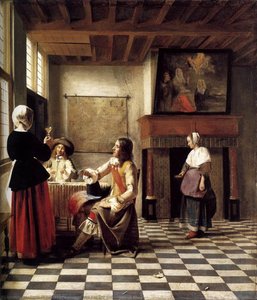
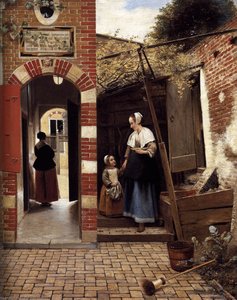
de hooch's work is characterized by its attention to detail, naturalism, and use of light. his paintings often featured everyday life, reflecting the values and aspirations of the emerging middle class. a notable example of this style is "the courtyard of a house in delft" (1658), which showcases his ability to capture the mundane details of everyday life. de hooch's work also shares themes and compositions with emanuel de witte, but his focus on people and their relationships sets him apart. this is evident in "woman nursing" (1658) and "woman with a baby on her lap" (1658), which demonstrate his interest in domestic scenes.

notable works and legacy

some of de hooch's most notable works include: de hooch's legacy can be seen in his influence on subsequent generations of artists, particularly in the impressionist and realist movements. his attention to light and shadow laid the groundwork for baroque painting.

museums and collections

de hooch's work can be found in various museums, including the koninklijk museum voor schone kunsten in antwerp, belgium, which features a vast collection of european art from the 15th to the 20th centuries. discover more about pieter de hooch and his works on Most-Famous-Paintings: [https://Most-Famous-Paintings.com/@/pieter-de-hooch](https://Most-Famous-Paintings.com/@/pieter-de-hooch) [https://Most-Famous-Paintings.com/art.nsf/o/a@d3b4kt](https://Most-Famous-Paintings.com/art.nsf/o/a@d3b4kt) (discover the masterpieces of koninklijk museum voor schone kunsten, belgium) note: the provided links are from Most-Famous-Paintings and are relevant to the topic. no external links were added as per the instructions.
Pieter de Hooch

Pieter de Hooch

1629 - 1694 , Netherlands

Quick Facts

  • Artistic Movement Or Style: Delft School, Dutch Golden Age
  • Artists Or Movements Influenced By This Artist: ['Jan Vermeer']
  • Artists Who Influenced This Artist: ['Nicolaes Berchem']
  • Date Of Birth: December 20, 1629
  • Full Name: Pieter Hendricksz de Hooch
  • Nationality: Dutch
  • Notable Artworks:
    • The Empty Glass
    • Woman Reading a Letter
    • Cardplayers in a sunlit room
    • A woman preparing bread and butter
  • Place Of Birth: Rotterdam, Netherlands
Explore artworks organized by themes, styles, and characteristics.