Wishlist Shopping Cart Cart
Buy print Buy printBuy Image Buy Image SendSend
DetailsDetails Add to favorites Add to favorites DownloadDownload SimilarsSimilars X-RayX-Ray DiaporamaDiaporama

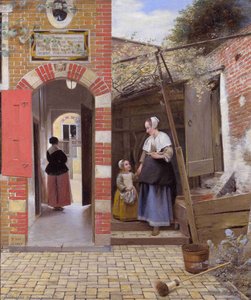
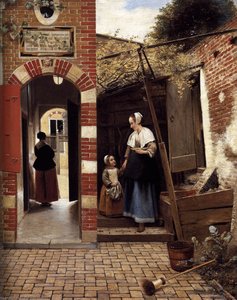
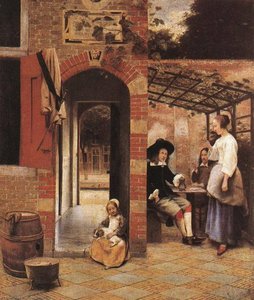
The Courtyard of a House in Delft

Pieter de Hooch (1629-1694) was a Dutch Golden Age painter renowned for his luminous portrayals of domestic interiors and serene courtyards. Influenced by Nicolas Berchem, he skillfully captured the essence of everyday life with remarkable realism.

Pieter de Hooch (1629-1694) was a Dutch Golden Age painter known for his luminous depictions of domestic life, architectural interiors & tranquil courtyards. Explore his realistic style and influence on Impressionism.

Hand Made Oil Reproduction

Hand-painted oil on canvas in your size and frame, made to order by our artists.

P118B $10
P118H $10
P118W $10
P438Z $10
P508JH $12
P508YH $12
P805H $10
P805Z $10
P919BZ $10
P919G $10
P919XJ $10
P959ZH $10
P968JZ $12
W106C $8
W218G $10
W218JH $8
W218Y $10
W307PJ $10
W316G $10
W316PJ $8
W316Y $10
W398PJ $8
W4111J $10
W500HY $15
W500JH $15
W692G $12
W849H $8
W940BG $15
W953PJ $8

Standard
custom
CM
INCH

Pick from our preset sizes that match the artwork's original proportions.

width
height

You may enter your own dimensions to fit a specific frame or space. If your selected size does not match the original image's proportions, we will either crop the artwork or extend the painting with additional hand-painted elements. A digital mockup will be sent for your approval before production begins.
Please note that the on-screen preview does not reflect the actual cropping or extension. Only the mockup will accurately show the final composition.
While custom sizes are available, we recommend selecting a dimension from the predefined list to preserve the original proportions.

Examples of what can be changed: Replace face with customer photo; Add pet (e.g., replace cat with dog); Include hidden message in background; Change background landscape or elements.
After order, Most-Famous-Paintings.com team will email client for instructions and provide a mockup preview

Worldwide Delivery () in 3/4 weeks instead of standard 5 weeks. (18 July). No compromise on quality.

why_choose_icon
Free Worldwide Express Shipping
why_choose_icon
High-Quality Linen Canvas
why_choose_icon
Full Shipping Insurance
why_choose_icon
Customs Tax Refund Guarantee
why_choose_icon
True Color Matching Guarantee
why_choose_icon
60-Day Return Policy (Defects Only)
why_choose_icon
100% Money-Back Guarantee
why_choose_icon
Bulk Discount Offer

Total Price

-

reproduction

The Courtyard of a House in Delft

Reproduction Medium

Reproduction Size

-

Total Price

-

Quick Facts

  • Location: The National Gallery, London
  • Year: 1658
  • Influences: Jacob Ochtervelt
  • Subject or theme: Urban courtyard scene
  • Dimensions: 73 x 60 cm
  • Artist: Pieter de Hooch
  • Notable elements or techniques: Light and shadow play; Atmospheric perspective

Art Quiz

There is only one correct answer for each question.

Question 1:
What artistic movement is Pieter de Hooch considered to be a precursor of?
Question 2:
The painting depicts a scene in which city?
Question 3:
What is the primary focus of 'The Courtyard of a House in Delft'?
Question 4:
De Hooch's use of light is particularly notable in this painting. What effect does he achieve?
Question 5:
Who mentored Pieter de Hooch during his formative artistic years?

Artwork Description

A Window into Delft’s Domestic Tranquility: Pieter de Hooch's “The Courtyard of a House in Delft”

Pieter de Hooch (1629-1694), a luminary of the Dutch Golden Age, stands as one of the foremost painters to capture the subtle beauty and quiet contemplation characteristic of his era. Born in Rotterdam, he embarked on an artistic journey that began under the tutelage of Nicolaes Berchem, honing his skills alongside Jacob Ochtervelt – formative influences that would shape his distinctive style and unwavering dedication to portraying scenes of everyday life with remarkable realism. “The Courtyard of a House in Delft,” completed in 1658, exemplifies this approach perfectly, cementing De Hooch’s reputation as an innovator who elevated domestic interiors to the level of profound artistic expression.

Capturing Light and Atmosphere: De Hooch's Innovative Technique

De Hooch’s genius resided not merely in meticulous observation but in his masterful manipulation of light – a technique that would foreshadow Impressionism decades later. Unlike many contemporaries who favored dramatic chiaroscuro, De Hooch employed diffused illumination to create an ethereal glow that permeated the courtyard space. This subtle layering of light and shadow lends an unparalleled sense of depth and realism to the painting, inviting viewers into a believable representation of domestic life. The artist skillfully utilized glazing – applying thin translucent layers of paint over previous coats – to achieve this luminous effect, enhancing color vibrancy and capturing the nuances of natural light filtering through windows.

A Portrait of Dutch Society: Contextualizing De Hooch’s Vision

“The Courtyard of a House in Delft” is more than just a depiction of an outdoor space; it's a snapshot of burgeoning Dutch society during the mid-17th century. The courtyard represents the idealised domestic environment embraced by the emerging middle class – a symbol of comfort, stability, and refinement. De Hooch’s subjects are presented with dignity and grace, reflecting the values of his time. Observing the women engaged in conversation, their gaze directed towards each other, speaks to the importance of social interaction and familial bonds within Dutch culture. The inclusion of a potted plant serves as a visual reminder of nature's influence on daily life, reinforcing De Hooch’s commitment to portraying scenes rooted in tangible reality.

Symbolism Within Simplicity: Exploring Layers of Meaning

Despite its apparent simplicity—a quiet courtyard bathed in soft light—the painting is replete with symbolic significance. The open doorway invites the viewer into a realm of intimacy and contemplation, mirroring the psychological depth achieved by De Hooch’s compositions. The positioning of the figures suggests a harmonious balance between activity and repose, reflecting the aspirations for a fulfilling life within the confines of the home. Furthermore, the muted palette—dominated by earthy tones—contributes to the painting's tranquil mood, conveying a sense of serenity and understated beauty that transcends mere visual representation.

Enduring Legacy: De Hooch’s Influence on Artistic Movements

Pieter de Hooch’s pioneering approach to light and composition profoundly impacted subsequent artistic movements, notably Impressionism. Artists like Claude Monet and Edgar Degas drew inspiration from De Hooch's ability to capture fleeting moments of atmosphere and emotion with remarkable accuracy. “The Courtyard of a House in Delft” continues to resonate with audiences today as a testament to the enduring power of understated beauty and the profound capacity for art to illuminate the human experience—a legacy secured by De Hooch’s unwavering dedication to portraying the quiet grandeur of everyday life.

Artist Biography

early life and training

pieter de hooch, a prominent figure in the dutch golden age, was born on december 20, 1629, in rotterdam, netherlands. he was the eldest of five children to hendrick hendricksz de hooch, a bricklayer, and annetge pieters, a midwife. little is known about his early life, but it is believed that he worked in rotterdam, delft, and amsterdam. de hooch's artistic training took place in haarlem under the landscape painter nicolaes berchem, alongside jacob ochtervelt. this period laid the foundation for his future success as a painter of quiet domestic scenes with an open doorway.

artistic style and themes

de hooch's work is characterized by its attention to detail, naturalism, and use of light. his paintings often featured everyday life, reflecting the values and aspirations of the emerging middle class. a notable example of this style is "the courtyard of a house in delft" (1658), which showcases his ability to capture the mundane details of everyday life. de hooch's work also shares themes and compositions with emanuel de witte, but his focus on people and their relationships sets him apart. this is evident in "woman nursing" (1658) and "woman with a baby on her lap" (1658), which demonstrate his interest in domestic scenes.

notable works and legacy

some of de hooch's most notable works include: de hooch's legacy can be seen in his influence on subsequent generations of artists, particularly in the impressionist and realist movements. his attention to light and shadow laid the groundwork for baroque painting.

museums and collections

de hooch's work can be found in various museums, including the koninklijk museum voor schone kunsten in antwerp, belgium, which features a vast collection of european art from the 15th to the 20th centuries. discover more about pieter de hooch and his works on Most-Famous-Paintings: [https://Most-Famous-Paintings.com/@/pieter-de-hooch](https://Most-Famous-Paintings.com/@/pieter-de-hooch) [https://Most-Famous-Paintings.com/art.nsf/o/a@d3b4kt](https://Most-Famous-Paintings.com/art.nsf/o/a@d3b4kt) (discover the masterpieces of koninklijk museum voor schone kunsten, belgium) note: the provided links are from Most-Famous-Paintings and are relevant to the topic. no external links were added as per the instructions.
Pieter de Hooch

Pieter de Hooch

1629 - 1694 , Netherlands

Quick Facts

  • Artistic Movement Or Style: Delft School, Dutch Golden Age
  • Artists Or Movements Influenced By This Artist: ['Jan Vermeer']
  • Artists Who Influenced This Artist: ['Nicolaes Berchem']
  • Date Of Birth: December 20, 1629
  • Full Name: Pieter Hendricksz de Hooch
  • Nationality: Dutch
  • Notable Artworks:
    • The Empty Glass
    • Woman Reading a Letter
    • Cardplayers in a sunlit room
    • A woman preparing bread and butter
  • Place Of Birth: Rotterdam, Netherlands
Explore artworks organized by themes, styles, and characteristics.