x


 Oil On CanvasWallArtRococo Realism
 175319th Century
 49.0 x 59.0 cm
 Laing Art Gallery
Hand-painted oil on canvas in your size and frame, made to order by our artists.





























Pick from our preset sizes that match the artwork's original proportions.

You may enter your own dimensions to fit a specific frame or space. If your selected size does not match the original image's proportions, we will either crop the artwork or extend the painting with additional hand-painted elements. A digital mockup will be sent for your approval before production begins.
Please note that the on-screen preview does not reflect the actual cropping or extension. Only the mockup will accurately show the final composition.
While custom sizes are available, we recommend selecting a dimension from the predefined list to preserve the original proportions.
Worldwide Delivery () in 3/4 weeks instead of standard 5 weeks. (18 July). No compromise on quality.


Peasant Ploughing with Two Horses
Reproduction Size
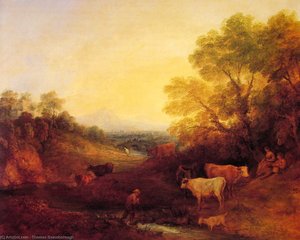
Thomas Gainsborough's “Peasant Ploughing with Two Horses,” painted in 1753, isn’t merely a depiction of agricultural labor; it’s a profound meditation on the relationship between humanity and the land. This remarkable work, now housed within the Laing Art Gallery in Newcastle upon Tyne, offers a glimpse into the heart of 18th-century England – a world where rural life was both arduous and deeply connected to the rhythms of nature. Gainsborough, a master of capturing light and atmosphere, eschews the grand narratives favored by his contemporaries, instead focusing on the quiet dignity of a simple scene: a farmer guiding two powerful horses as they till the soil.
The painting’s genesis lies within Gainsborough's evolving artistic philosophy. Initially trained in portraiture, he gradually shifted his focus to landscape, seeking to capture the essence of the English countryside – not through idealized romanticism, but with a keen eye for observation and a subtle understanding of light and shadow. “Peasant Ploughing” exemplifies this shift, moving beyond mere representation to convey a sense of mood and atmosphere. The composition is carefully balanced, drawing the viewer’s eye from the sturdy figures in the foreground towards the expansive sky above, creating a harmonious blend of human activity and natural beauty.
Gainsborough's technical skill is immediately apparent in his masterful use of light. He employs a technique known as ‘chiaroscuro’ – the dramatic contrast between light and dark – to sculpt the forms of the figures and the landscape, lending them depth and realism. The warm glow of the afternoon sun bathes the field and the animals, while subtle shadows define their contours. Notice how he uses broken color—small patches of vibrant hues—to suggest texture and detail in the clothing, the horses’ coats, and the plowed earth. This technique creates a sense of immediacy and vitality, as if we are witnessing this scene unfold before our eyes.
Beyond its aesthetic qualities, “Peasant Ploughing” carries significant symbolic weight. The farmer, a figure of quiet strength and determination, embodies the virtues of hard work and resilience – values deeply ingrained in rural society at the time. The horses, symbols of power and labor, represent the essential role of agriculture in sustaining life. The painting subtly critiques the social hierarchy of the era, presenting a humble scene of rural life without romanticizing it. It’s a reminder that beauty and dignity can be found even in the most commonplace activities.
Interestingly, the painting resonates with earlier Dutch landscape masters like Jacob van Ruysdael and Paulus Potter, whose works emphasized the connection between humans and animals within the natural world. Gainsborough clearly admired these artists and incorporated their techniques into his own style. The scene’s resemblance to Rosa Bonheur's "Ploughing in the Nivernais" (1849), a later work depicting oxen ploughing, highlights this influence and speaks to the enduring appeal of portraying rural labor.
Reproductions of “Peasant Ploughing with Two Horses” offer a wonderful opportunity to bring this iconic artwork into your home or office. Available in various sizes and mediums, including high-quality canvas prints and framed fine art reproductions, these pieces capture the essence of Gainsborough’s vision while preserving the rich detail and atmospheric quality of the original painting. Consider framing options that complement the artwork's palette and style – a simple wooden frame will enhance the rustic charm, while a more contemporary design can create a striking contrast.

1727 - 1788 , United Kingdom

Explore the captivating world of Henry Thomas Dawson (1811-1878), a master of Victorian marine painting. Discover his evocative coastal scenes, landscapes & lasting artistic legacy. Learn about collecting Dawson's work and find reproductions at Most-Famous-Paintings.

Explore the life & art of George Barret Sr., a pioneer of British pastoral painting. Discover his influence on Romantic landscape art, patronage, and collecting tips from Most-Famous-Paintings.

Explore the world of Grant Wood & American Regionalism with Most-Famous-Paintings. Discover the symbolism behind 'American Gothic', recurring themes, and the movement's lasting impact on art history. High-quality reproductions available.

Explore the captivating genre scenes of Thomas George Webster, a Victorian painter bridging British traditions with American themes. Discover his style, influences & legacy in 19th-century art history.

Explore the life & work of Reginald Grenville Eves, a leading British portraitist who transitioned to captivating landscape painting. Discover his legacy and prominent works at Most-Famous-Paintings.


Stay updated with the latest art news, exclusive offers, and decoration ideas.
Tell us about your project and our art experts will provide you with 3 personalized art suggestions.
Let Us Curate 3 Options Just for You - Free!


 Buy print
 Send
Send Share
Share
 Details

 Download
 Similars
 X-Ray
X-Ray Diaporama
 Read More







 Glass option is only available in size under 110 CM