x

 Oil On CanvasWallArtCubism
 2008
2008 77.0 x 76.0 cm
 Ibrahimi Collection
Hand-painted oil on canvas in your size and frame, made to order by our artists.





























Pick from our preset sizes that match the artwork's original proportions.

You may enter your own dimensions to fit a specific frame or space. If your selected size does not match the original image's proportions, we will either crop the artwork or extend the painting with additional hand-painted elements. A digital mockup will be sent for your approval before production begins.
Please note that the on-screen preview does not reflect the actual cropping or extension. Only the mockup will accurately show the final composition.
While custom sizes are available, we recommend selecting a dimension from the predefined list to preserve the original proportions.
Worldwide Delivery () in 3/4 weeks instead of standard 5 weeks. (18 July). No compromise on quality.


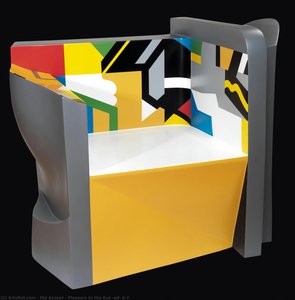
Chair
Reproduction Size
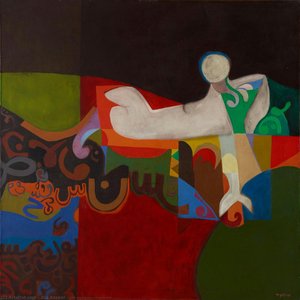
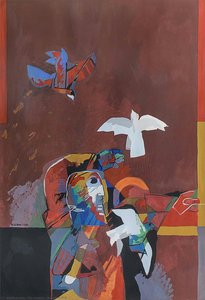
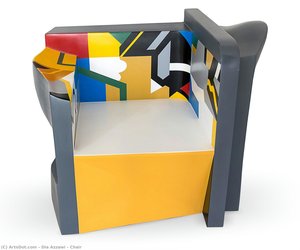
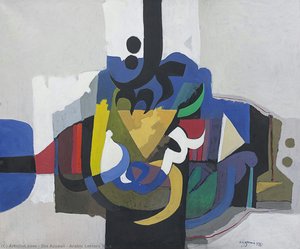
To stand before Dia al-Azzawi’s Chair is not merely to observe an object, but to witness a profound intellectual dismantling of perception itself. This piece transcends the mere function of furniture; it becomes a vibrant meditation on structure, viewpoint, and the very act of seeing. The artist has taken something utterly commonplace—a chair—and subjected it to the rigorous, exhilarating logic of Cubism. What greets the eye is not the comforting solidity of reality, but an energetic constellation of overlapping planes and sharp, defined angles. It forces the viewer into a dynamic relationship with the canvas, suggesting that any single viewpoint is inherently incomplete.
Dia al-Azzawi’s artistic journey is deeply rooted in the rich, complex tapestry of Mesopotamian culture, yet his language speaks fluently in the dialect of global modernism. Born in Baghdad, his formative years provided him with an innate understanding of deep symbolism drawn from ancient civilizations. When he engages with a style like Cubism—a movement born from early 20th-century European upheaval—it is never a mere imitation. Instead, it becomes a powerful synthesis. The fragmentation seen here echoes the historical turbulence that has shaped his homeland; it suggests resilience found within deconstruction. The chair, therefore, carries the weight of cultural memory, rendered through a lens of geometric dynamism.
The execution is masterful in its apparent simplicity and profound complexity. Al-Azzawi employs a palette that sings with bold, unmodulated primary and secondary colors. There is no gentle blending here; instead, the paint is applied in flat, graphic planes, allowing each geometric facet to assert its presence independently. This technique emphasizes line—the sharp delineation between one plane and the next—creating an optical vibration across the surface. The overall effect is startlingly vibrant, a controlled explosion of color contained within the rigid framework of abstraction. It speaks to a painter who commands both technical precision and emotional abandon.
For the collector or designer seeking an anchor piece that sparks conversation, Chair offers immense depth. Symbolically, the work invites contemplation on multiple perspectives—the idea that truth, like a chair viewed from every angle, is multifaceted. Emotionally, the painting pulses with energy; it is intellectually stimulating and visually exhilarating. Reproducing this artwork allows one to bring this controlled burst of sophisticated energy into a contemporary space. It functions as both a brilliant piece of abstract art and a thoughtful cultural artifact, suggesting that even the most mundane aspects of life can be elevated to realms of profound artistic inquiry.


1939 - , Iraq
Journey through Wassily Kandinsky's 25 most iconic abstract paintings. Explore his revolutionary use of color, form & spiritual expressionism. Find museum-quality Kandinsky reproductions and elevate your home decor with Most-Famous-Paintings.com. Discover all masterpieces on Most-Famous-Paintings.com!
Explore 25 iconic Fernand Léger paintings that defined the Machine Age & Cubism. Discover the stories behind his bold colors, geometric forms & avant-garde style. Find museum-quality art reproductions on Most-Famous-Paintings.com.
Explore 10 defining masterpieces of Geometric Abstraction! Discover Kandinsky, Mondrian & Malevich’s iconic works. Find museum-quality art reproductions and curated decor ideas to elevate your home at Most-Famous-Paintings.com.
Explore 25 iconic Georges Braque paintings that revolutionized Cubism & modern art. Discover the stories behind his masterpieces, from Fauvism to Analytical Cubism. Find museum-quality reproductions & elevate your home decor with Most-Famous-Paintings.com.

Journey through 25 iconic artworks at the Metropolitan Museum of Art! Explore Van Gogh, Monet, Rembrandt & more. Discover art history, inspiring stories, and museum-quality reproductions to elevate your home decor. Explore the full collection on Most-Famous-Paintings.com.


Stay updated with the latest art news, exclusive offers, and decoration ideas.
Tell us about your project and our art experts will provide you with 3 personalized art suggestions.
Let Us Curate 3 Options Just for You - Free!


 Buy print
 Send
Send Share
Share
 Details

 Download
 Similars
 X-Ray
X-Ray Diaporama
 Read More







 Glass option is only available in size under 110 CM