x


 Oil On CanvasWallArtCubism
 1971Modern
 88.0 x 63.0 cm
 Ibrahimi Collection
Hand-painted oil on canvas in your size and frame, made to order by our artists.
Pick from our preset sizes that match the artwork's original proportions.

You may enter your own dimensions to fit a specific frame or space. If your selected size does not match the original image's proportions, we will either crop the artwork or extend the painting with additional hand-painted elements. A digital mockup will be sent for your approval before production begins.
Please note that the on-screen preview does not reflect the actual cropping or extension. Only the mockup will accurately show the final composition.
While custom sizes are available, we recommend selecting a dimension from the predefined list to preserve the original proportions.
Worldwide Delivery () in 3/4 weeks instead of standard 5 weeks. (18 July). No compromise on quality.


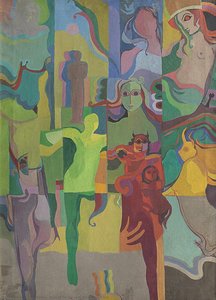
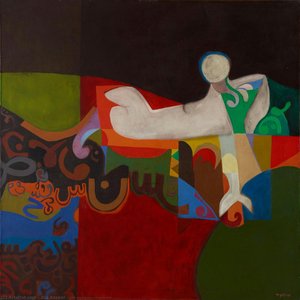
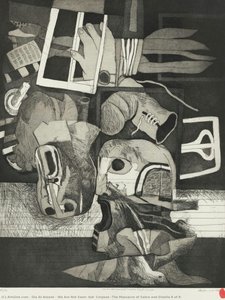
Saga of the Descent of Goddess Ishtar
Reproduction Size
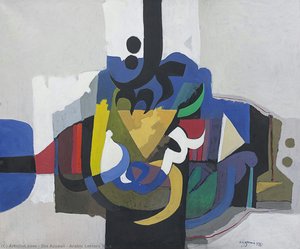
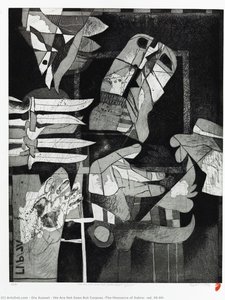
In the mesmerizing masterpiece Saga of the Descent of Goddess Ishtar, the renowned Iraqi artist Dia al-Azzawi orchestrates a profound visual symphony that bridges the ancient echoes of Mesopotamia with the fractured energy of modernism. Created in 1971, this work serves as a vibrant portal into the mythos of the Queen of Heaven. The painting does not merely depict a story; it deconstructs it, utilizing a Cubist-inspired language to explore the multifaceted nature of Ishtar—the goddess of love, war, and beauty. As the viewer’s eye wanders across the canvas, they encounter a world where the boundaries between the divine and the earthly are blurred through overlapping planes and geometric rhythms, inviting a deep, meditative engagement with the legends of Uruk.
The composition is a masterclass in structured dynamism, organized into a grid-like arrangement of vertical panels that act as windows into different stages of a mythic journey. Al-Azzawi employs a sophisticated Cubist approach, breaking down figures and celestial symbols into a mosaic of geometric blocks. This fragmentation serves a higher purpose: it mirrors the complexity of the goddess herself, whose identity encompasses both the tenderness of a bouquet of flowers and the ferocity of a lion. Through the use of flattened, two-dimensional perspectives and a lack of traditional light sources, the artist creates an internal luminosity. The interplay of warm ochres and reds against cool blues and greens generates a rhythmic pulse, guiding the observer through a narrative progression that feels both ancient and avant-garde.
Beyond its formal brilliance, the artwork resonates with a deep emotional and political weight. Al-Azzawi, a pioneer of the New Vision group, often infused his work with themes of identity and conflict, and here, the shattered forms can be seen as a metaphor for the fragmentation of history and the psychological impact of upheaval. The technique—applying oil paint in deliberate, flat planes with minimal blending—emphasizes the structural integrity of the piece, making it a striking focal point for any sophisticated interior. For the collector or designer, this painting offers more than mere decoration; it provides a profound intellectual anchor. It is an evocative piece that commands attention through its rich cultural heritage and its bold, unapologetic embrace of abstraction, making it an incomparable addition to a collection dedicated to the intersection of myth and modern art.


1939 - , Iraq

Journey through 25 iconic artworks at the Metropolitan Museum of Art! Explore Van Gogh, Monet, Rembrandt & more. Discover art history, inspiring stories, and museum-quality reproductions to elevate your home decor. Explore the full collection on Most-Famous-Paintings.com.

Journey through 25 iconic artworks at the Detroit Institute of Arts! Explore Van Gogh, Monet, Rembrandt & more. Discover art history, stunning techniques & find museum-quality reproductions to elevate your home decor on Most-Famous-Paintings.com.
Explore 25 iconic artworks from Washington DC's National Gallery of Art! Discover masterpieces by Cézanne, Matisse & Picasso. Find museum-quality art reproductions and elevate your home decor with timeless paintings. Explore the full collection online at Most-Famous-Paintings.com.
Journey through 25 iconic James Abbott McNeill Whistler paintings! Explore his masterpieces of Aestheticism, from 'Nocturne in Black and Gold' to captivating portraits. Find museum-quality art reproductions & elevate your home decor with Most-Famous-Paintings.com. Discover the full collection online.
Journey through Henri Matisse's 25 most iconic paintings! Explore Fauvism, vibrant colors & the stories behind masterpieces like 'The Dance'. Find museum-quality art reproductions and curated decor ideas to elevate your space. Discover all masterpieces on Most-Famous-Paintings.com.


Stay updated with the latest art news, exclusive offers, and decoration ideas.
Tell us about your project and our art experts will provide you with 3 personalized art suggestions.
Let Us Curate 3 Options Just for You - Free!


 Buy print
 Send
Send Share
Share
 Details

 Download
 Similars
 X-Ray
X-Ray Diaporama
 Read More




































 Glass option is only available in size under 110 CM