Wishlist Shopping Cart Cart
Buy print Buy printBuy Image Buy Image SendSend
DetailsDetails Add to favorites Add to favorites DownloadDownload SimilarsSimilars X-RayX-Ray DiaporamaDiaporama

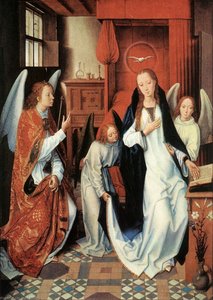
The Annunciation

Hans Memling’s ‘The Annunciation,’ painted in 1480, showcases a breathtakingly serene scene of Mary receiving the divine message with exquisite detail and luminous oil painting. Discover this masterpiece by the Bruges master and bring its timeless beauty into your home.

Discover Hans Memling’s stunning Early Netherlandish paintings in Bruges! Explore religious scenes & portraits at the Memling Museum, a Flemish Primitive masterpiece.

Hand Made Oil Reproduction

Hand-painted oil on canvas in your size and frame, made to order by our artists.

P118B $10
P118H $10
P118W $10
P438Z $10
P508JH $12
P508YH $12
P805H $10
P805Z $10
P919BZ $10
P919G $10
P919XJ $10
P959ZH $10
P968JZ $12
W106C $8
W218G $10
W218JH $8
W218Y $10
W307PJ $10
W316G $10
W316PJ $8
W316Y $10
W398PJ $8
W4111J $10
W500HY $15
W500JH $15
W692G $12
W849H $8
W940BG $15
W953PJ $8

Standard
custom
CM
INCH

Pick from our preset sizes that match the artwork's original proportions.

width
height

You may enter your own dimensions to fit a specific frame or space. If your selected size does not match the original image's proportions, we will either crop the artwork or extend the painting with additional hand-painted elements. A digital mockup will be sent for your approval before production begins.
Please note that the on-screen preview does not reflect the actual cropping or extension. Only the mockup will accurately show the final composition.
While custom sizes are available, we recommend selecting a dimension from the predefined list to preserve the original proportions.

Examples of what can be changed: Replace face with customer photo; Add pet (e.g., replace cat with dog); Include hidden message in background; Change background landscape or elements.
After order, Most-Famous-Paintings.com team will email client for instructions and provide a mockup preview

Worldwide Delivery () in 3/4 weeks instead of standard 5 weeks. (18 July). No compromise on quality.

why_choose_icon
Free Worldwide Express Shipping
why_choose_icon
High-Quality Linen Canvas
why_choose_icon
Full Shipping Insurance
why_choose_icon
Customs Tax Refund Guarantee
why_choose_icon
True Color Matching Guarantee
why_choose_icon
60-Day Return Policy (Defects Only)
why_choose_icon
100% Money-Back Guarantee
why_choose_icon
Bulk Discount Offer

Total Price

-

reproduction

The Annunciation

Reproduction Medium

Reproduction Size

-

Total Price

-

Quick Facts

  • Location: Metropolitan Museum of Art, New York
  • Subject or theme: Religious Narrative
  • Dimensions: 77 x 55 cm
  • Medium: Oil on canvas
  • Notable elements or techniques: Light and shadow play; Symbolism (water carafe & lilies)
  • Artistic style: Realistic depiction; Detailed observation
  • Title: The Annunciation

Art Quiz

There is only one correct answer for each question.

Question 1:
What artistic influence is evident in Hans Memling’s depiction of the Annunciation?
Question 2:
The lily depicted in the painting symbolizes:
Question 3:
Where is Hans Memling’s ‘The Annunciation’ currently housed?
Question 4:
What is Memling’s primary inspiration for his rendition of the Annunciation?
Question 5:
The candleholder in the painting represents:

Artwork Description

A Moment Frozen in Divine Grace: Hans Memling’s The Annunciation

Hans Memling's *The Annunciation*, completed in 1480, stands as a testament to the artistic brilliance of Early Netherlandish painting—a movement renowned for its meticulous realism and profound spiritual depth. Executed during Bruges’ golden age as a center for art patronage, this masterpiece resides within the Metropolitan Museum of Art in New York City, measuring 77 x 55 cm and showcasing Memling's unparalleled skill in capturing both visual beauty and symbolic resonance. Inspired by Rogier van der Weyden’s monumental Saint Columba Altarpiece—which itself drew heavily from Byzantine iconography—Memling departed from conventional depictions of the Virgin Mary receiving Gabriel’s proclamation. Instead, he presented a strikingly innovative scene: Mary swooning gently upon her bedchamber mattress, supported by two angelic figures radiating compassion and serenity. This departure from established artistic precedent underscores Memling's willingness to experiment with visual language while remaining firmly rooted in the traditions of his time.
  • Style & Technique: Memling’s approach aligns seamlessly with the broader stylistic currents of the fifteenth century, mirroring the influence of Jan van Eyck and prioritizing naturalistic detail alongside meticulous modeling—a technique perfected by Memling himself. The oil paint medium allowed for unprecedented luminosity and textural richness, capturing the subtle nuances of light and shadow within the intimate setting.
  • Composition & Setting: The painting’s composition is carefully balanced, placing Gabriel and Mary centrally against a backdrop of a richly ornamented bedchamber. Architectural elements like the tiled floor and arched window contribute to a sense of depth and realism, transporting viewers into the sacred space depicted. Notably, Memling incorporated symbolic objects—a carafe of water illuminated by candlelight and a vase brimming with lilies—to reinforce themes of purity and divine grace.
  • Symbolism & Narrative Depth: Beyond its visual splendor, *The Annunciation* is laden with theological significance. Gabriel’s priestly garb references the ritual of Mass, symbolizing Christ's incarnation as the Light of the World. The angel’s lily serves as a potent emblem of Mary’s virginity and innocence, while the empty candleholder signifies her role as herald of salvation—a visual metaphor that elevates the scene beyond mere representation into a profound meditation on faith and divine grace.
  • Historical Context: Memling's work reflects the intellectual fervor of the Renaissance, fueled by humanist scholarship and a renewed interest in classical ideals. However, unlike many artists of his era who embraced secular themes, Memling steadfastly maintained a focus on religious iconography—a commitment that cemented his reputation as one of Bruges’ foremost artistic luminaries.
  • Emotional Impact: The soft glow emanating from the room imbues *The Annunciation* with an aura of tranquility and reverence. Memling skillfully evokes a feeling of solemn contemplation, inviting viewers to contemplate the miraculous event at the heart of Christian belief—a timeless depiction of divine grace and human humility.

This exquisite reproduction captures not only the visual splendor of Memling’s original but also its enduring spiritual power, offering an unparalleled opportunity to experience the beauty and contemplation inherent in this iconic masterpiece.

Artist Biography

Hans Memling: The Bruges Master of Detail and Patronage

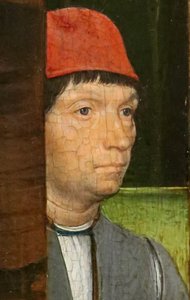
Hans Memling (c. 1430 – August 11, 1494), born in Seligenstadt, Germany, stands as a pivotal figure in Early Netherlandish painting—a movement characterized by exquisite realism, meticulous observation of nature, and profound spiritual contemplation. Though his formative years were spent primarily within the Rhineland’s artistic milieu, Memling's trajectory ultimately led him to Bruges, Belgium, where he established himself as one of the foremost artists of his time and cultivated a prolific workshop that disseminated his distinctive style across Europe.
  • Early Life & Apprenticeship: Precise biographical details surrounding Memling’s birth remain elusive, yet scholarly consensus suggests he emerged from Mainz around 1430. His artistic education commenced under the tutelage of Rogier van der Weyden, a titan of Flemish painting whose mastery of oil paint and sculptural modeling profoundly shaped Memling's technique. This apprenticeship instilled in him an unwavering dedication to detail—a hallmark that would define his oeuvre.
  • Bruges & The Workshop: By 1465, Memling secured citizenship in Bruges, a burgeoning commercial hub and artistic epicenter. Recognizing the potential for collaborative creativity, he founded a workshop staffed by numerous assistants, fostering an environment of innovation and stylistic consistency. This workshop became renowned for producing stunning reproductions of masterpieces—a testament to Memling’s skill as both artist and pedagogue.

A Style Defined by Precision & Patronage

Memling's artistic style is instantly recognizable: characterized by luminous color palettes, delicately rendered drapery folds, and an astonishing level of anatomical accuracy. He meticulously studied human anatomy—drawing inspiration from classical sculpture—to achieve unparalleled realism in his portraits and religious scenes alike. Unlike many contemporaries who favored expressive brushstrokes, Memling prioritized meticulous observation and painstaking execution, resulting in images imbued with serene beauty and profound spiritual depth.
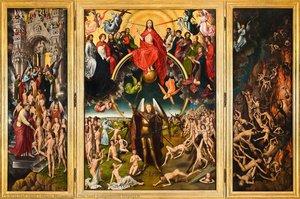
  • Religious Commissions: Memling’s reputation soared thanks to lucrative commissions from wealthy patrons—primarily clergymen and aristocratic families—who sought depictions of saints and biblical narratives that resonated with piety and prestige. Notable examples include “The Last Judgment” at St John's Hospital in Bruges, a monumental fresco showcasing Memling’s masterful compositional skills and dramatic use of color.
  • Portraiture: Memling excelled as a portraitist, capturing the likenesses of prominent figures with remarkable sensitivity and psychological insight. His portraits—such as “Portrait of a Man with an Arrow”—demonstrate his ability to convey character through subtle gestures and facial expressions—a skill that cemented his place among the greatest artists of his era.

Influence & Legacy

Memling’s artistic legacy extends far beyond his own lifetime. His workshop produced a vast array of paintings—many bearing stylistic similarities to his original works—that propagated Memling's distinctive aesthetic across Flanders and beyond. Furthermore, Memling’s meticulous technique served as an inspiration for subsequent generations of artists—particularly Quentin Massys, who established the Antwerp School—solidifying Memling’s position as a cornerstone of Flemish Renaissance art.

Rediscovery & Enduring Popularity

Memling's artistic achievements were largely forgotten until the 19th century when scholars rediscovered his paintings and championed his genius. Today, Memling’s works—particularly “The Last Judgment”—continue to captivate audiences worldwide, serving as enduring symbols of artistic excellence and spiritual contemplation. His meticulous attention to detail and profound understanding of human psychology remain remarkably relevant in our contemporary appreciation of art history.

Quick Facts

  • Artistic Movement Or Style: Early Netherlandish Painting
  • Artists Or Movements Influenced By This Artist: ['Flemish Primitive']
  • Artists Who Influenced This Artist: ['Rogier van der Weyden']
  • Date Of Birth: c. 1430
  • Date Of Death: 11 august 1494
  • Full Name: Hans Memling
  • Nationality: German-Flemish
  • Notable Artworks:
    • St Johns Hospital
    • The Last Judgement
    • Scenes from the Passion
  • Place Of Birth: Seligenstadt, Germany
Explore artworks organized by themes, styles, and characteristics.