x


 Acrylic On CanvasWallArtDutch Golden Age
 1659
1659 70.0 x 60.0 cm
 National Gallery of Art
Hand-painted oil on canvas in your size and frame, made to order by our artists.





























Pick from our preset sizes that match the artwork's original proportions.

You may enter your own dimensions to fit a specific frame or space. If your selected size does not match the original image's proportions, we will either crop the artwork or extend the painting with additional hand-painted elements. A digital mockup will be sent for your approval before production begins.
Please note that the on-screen preview does not reflect the actual cropping or extension. Only the mockup will accurately show the final composition.
While custom sizes are available, we recommend selecting a dimension from the predefined list to preserve the original proportions.
Worldwide Delivery () in 3/4 weeks instead of standard 5 weeks. (18 July). No compromise on quality.


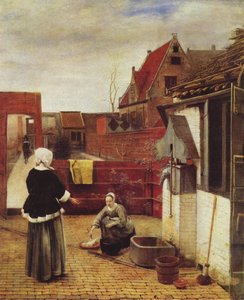
A Dutch Courtyard
Reproduction Size
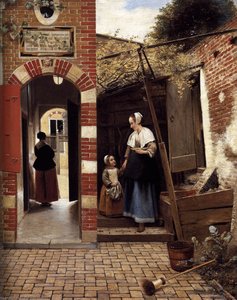
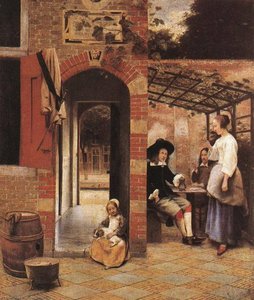
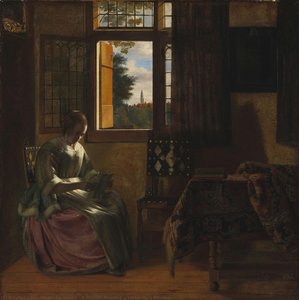
Pieter de Hooch’s “A Dutch Courtyard,” painted in 1658-1660, isn't merely a depiction of a domestic scene; it’s a carefully constructed window into the burgeoning middle class life of 17th-century Delft. This luminous work, now residing within the National Gallery of Art in Washington D.C., captures a fleeting moment of convivial relaxation – soldiers sharing a drink with a maidservant amidst the brick and timber of a typical Dutch courtyard. De Hooch, a master of the “Delft School,” eschewed grand narratives or dramatic events, instead focusing on the subtle poetry of everyday existence, a hallmark that would later influence Impressionist painters.
The painting’s power lies not in overt action but in its exquisite observation and masterful use of light. De Hooch expertly employs chiaroscuro – the interplay of light and shadow – to create a sense of depth and intimacy within the confined space. The muted palette, dominated by earthy browns, creams, and subtle blues, evokes a feeling of quiet warmth and domestic comfort. Notice how the sunlight streams through the open doorway, illuminating the figures and casting long shadows that define their forms and suggest the surrounding architecture.
Delft during this period was a thriving center for trade and craftsmanship, and De Hooch’s work offers a glimpse into the lives of its prosperous merchants and artisans. The courtyard itself represents a microcosm of urban life – a private sanctuary nestled within the bustling city. The soldiers, likely mercenaries or guards, are engaged in relaxed conversation, while the maidservant attends to their needs with quiet efficiency. This scene reflects the social dynamics of the time, where leisure and hospitality were valued symbols of status.
The inclusion of the Nieuwe Kerk tower in the background is a deliberate detail, anchoring the scene firmly within Delft’s urban landscape. It subtly reminds us that this seemingly ordinary courtyard exists within a larger context – a vibrant city brimming with commerce, culture, and social interaction. The distant church also serves as a visual link to the religious values of the era, suggesting an underlying sense of order and morality.
De Hooch’s technique is characterized by its meticulous detail and remarkable naturalism. He employed a layering method, applying thin, transparent glazes of paint to build up color and texture gradually. This approach creates a shimmering effect, particularly noticeable in the fabrics and skin tones. The artist's use of impasto – small dabs of paint applied with a delicate touch – adds subtle variations in tone and highlights, contributing to the painting’s luminous quality.
Furthermore, De Hooch was a master of capturing the nuances of human expression. Observe how the soldiers exchange glances, conveying a sense of camaraderie and shared amusement. The maidservant's posture and gaze suggest attentiveness and perhaps even a hint of playful interaction. These subtle gestures reveal a deep understanding of human psychology – a skill that sets De Hooch apart from many of his contemporaries.
“A Dutch Courtyard” stands as a testament to De Hooch’s ability to find beauty in the mundane. It's a painting that invites us to slow down, observe, and appreciate the simple pleasures of life. Its enduring appeal lies not only in its technical brilliance but also in its evocative portrayal of human connection and the quiet harmony of everyday existence. Today, reproductions like those offered by Most-Famous-Paintings allow art lovers worldwide to experience this remarkable work of Dutch Golden Age painting.


1629 - 1694 , Netherlands

Journey into the Dutch Golden Age! Explore 10 iconic paintings by Rembrandt, Vermeer & Hals. Discover the stories behind these Baroque masterpieces and find museum-quality art reproductions to elevate your home decor on .
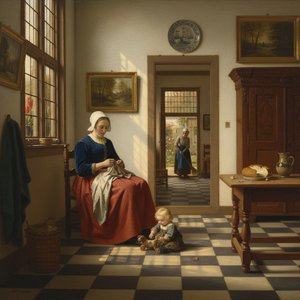
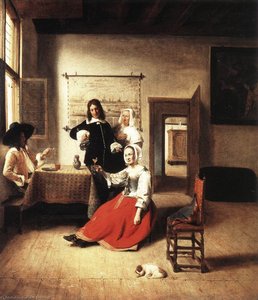
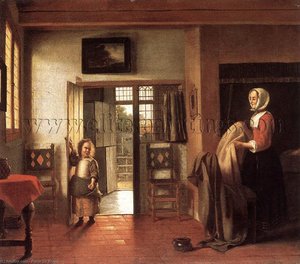
Explore the captivating world of Pieter de Hooch, a master of Dutch Golden Age painting. Discover his innovative use of light, intimate domestic scenes, and lasting influence on art history. Learn more at Most-Famous-Paintings.
Explore the Dutch Golden Age of painting! Discover key artists like Vermeer & ter Borch, their innovative techniques, and the rich cultural context behind these Baroque masterpieces. Learn about collecting & appreciating this iconic art period.

Explore the captivating genre paintings of John George Brown, celebrated for his realistic depictions of 19th-century American life. Discover his legacy & find museum-quality reproductions at Most-Famous-Paintings.

Explore the captivating Orientalist paintings of John Frederick Lewis! Discover his mastery of detail, genre scenes & influence on 19th-century British art. Learn about his life, techniques & legacy at Most-Famous-Paintings.


Stay updated with the latest art news, exclusive offers, and decoration ideas.
Tell us about your project and our art experts will provide you with 3 personalized art suggestions.
Let Us Curate 3 Options Just for You - Free!


 Buy print
 Send
Send Share
Share
 Details

 Download
 Similars
 X-Ray
X-Ray Diaporama
 Read More







 Glass option is only available in size under 110 CM