x


 OilWallArtDutch Golden Age
 1665Early Modern
 70.0 x 62.0 cm
Hand-painted oil on canvas in your size and frame, made to order by our artists.





























Pick from our preset sizes that match the artwork's original proportions.

You may enter your own dimensions to fit a specific frame or space. If your selected size does not match the original image's proportions, we will either crop the artwork or extend the painting with additional hand-painted elements. A digital mockup will be sent for your approval before production begins.
Please note that the on-screen preview does not reflect the actual cropping or extension. Only the mockup will accurately show the final composition.
While custom sizes are available, we recommend selecting a dimension from the predefined list to preserve the original proportions.
Worldwide Delivery () in 3/4 weeks instead of standard 5 weeks. (18 July). No compromise on quality.


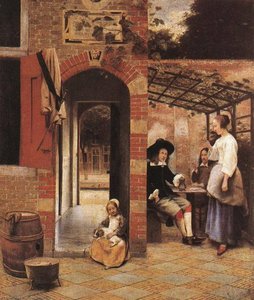
A Game of Ninepins
Reproduction Size
In the quiet, sun-drenched streets of seventeenth-century Holland, life unfolded with a rhythmic, communal grace, a sentiment captured masterfully by Pieter de Hooch in his 1665 masterpiece, A Game of Ninepins. This evocative scene invites the viewer to step out of the modern rush and into a moment of shared leisure. De Hooch, a luminary of the Dutch Golden Age, possessed an unparalleled ability to transform the mundane into the monumental. Here, the simple act of playing ninepins becomes a vibrant tableau of social cohesion. The painting breathes with the energy of a neighborhood gathering, where the clatter of wooden pins and the low murmur of conversation seem almost audible through the layers of oil pigment.
The composition is a delicate dance of figures and light. As we gaze upon the street scene, our eyes are led through a carefully orchestrated space, moving from the immediate presence of the players to the architectural depth of the background. A woman, captured in a moment of focused participation, holds a bowl, perhaps containing refreshments for the group, grounding the scene in domestic reality. Nearby, a watchful dog lingers in the shadows, adding a touch of warmth and organic life to the human drama. The scattered pins across the ground serve as silent witnesses to the ongoing play, suggesting a day well-spent in the pursuit of simple joys.
Technically, A Game of Ninepins showcases De Hooch’s signature command over light and perspective. His training under Nicolaes Berchem instilled in him a profound respect for naturalism, which he applied here to capture the way sunlight filters through an outdoor setting, casting soft shadows and illuminating textures with breathtaking clarity. The artist utilizes a subtle palette of earthy tones, punctuated by the bright whites and muted colors of the players' attire, creating a sense of harmony that is both soothing and visually stimulating. His ability to create "open doorways"—a hallmark of his style—is present here not through literal architecture, but through the way he opens the viewer's gaze from the foreground activity into the deeper, sunlit recesses of the street.
For the discerning collector or interior designer, this work offers more than mere decoration; it provides an emotional anchor. The painting radiates a sense of gezelligheid—the uniquely Dutch concept of coziness, conviviality, and social belonging. It is a piece that evokes nostalgia for a time when community was found in the shared spaces of the street. When rendered as a high-quality hand-painted reproduction, the textures of the brushwork and the luminosity of the light can transform a room, offering a sophisticated focal point that inspires contemplation and warmth. Whether placed in a grand gallery or a quiet study, De Hooch’s vision remains a timeless testament to the beauty found in the everyday.


1629 - 1694 , Netherlands

Journey into the Dutch Golden Age! Explore 10 iconic paintings by Rembrandt, Vermeer & Hals. Discover the stories behind these Baroque masterpieces and find museum-quality art reproductions to elevate your home decor on .
Explore the Dutch Golden Age of painting! Discover key artists like Vermeer & ter Borch, their innovative techniques, and the rich cultural context behind these Baroque masterpieces. Learn about collecting & appreciating this iconic art period.

Explore the captivating winter landscapes of Charles Leickert, a master of Dutch Golden Age light & atmosphere. Discover his techniques, symbolism, and lasting legacy – a comprehensive study for art enthusiasts and collectors.

Explore the Dutch Golden Age of painting with Most-Famous-Paintings. Discover Rembrandt, Vermeer & other Masters. Learn about key characteristics, iconic artworks, and lasting influence. Expert insights for collectors & enthusiasts.

Explore the Dutch Golden Age of painting (1600-1700) with Most-Famous-Paintings. Discover Rembrandt, Vermeer & other masters. Learn about techniques, history & find museum-quality reproductions.


Stay updated with the latest art news, exclusive offers, and decoration ideas.
Tell us about your project and our art experts will provide you with 3 personalized art suggestions.
Let Us Curate 3 Options Just for You - Free!


 Buy print
 Send
Send Share
Share
 Details

 Download
 Similars
 X-Ray
X-Ray Diaporama
 Read More







 Glass option is only available in size under 110 CM