x


 Oil On CanvasWallArtDutch Golden Age
 1558
1558 68.0 x 56.0 cm
 Fine Arts Museums of San Francisco
Hand-painted oil on canvas in your size and frame, made to order by our artists.





























Pick from our preset sizes that match the artwork's original proportions.

You may enter your own dimensions to fit a specific frame or space. If your selected size does not match the original image's proportions, we will either crop the artwork or extend the painting with additional hand-painted elements. A digital mockup will be sent for your approval before production begins.
Please note that the on-screen preview does not reflect the actual cropping or extension. Only the mockup will accurately show the final composition.
While custom sizes are available, we recommend selecting a dimension from the predefined list to preserve the original proportions.
Worldwide Delivery () in 3/4 weeks instead of standard 5 weeks. (18 July). No compromise on quality.


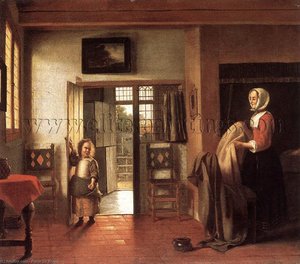
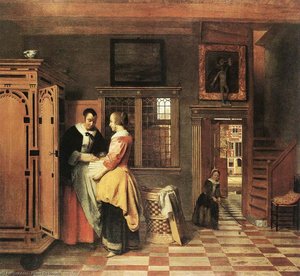
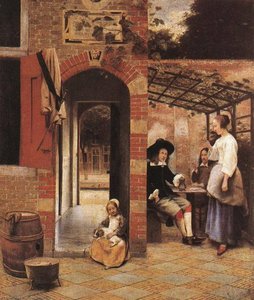
A Woman Nursing an Infant with a Child and a Dog
Reproduction Size
Pieter de Hooch's “A Woman Nursing an Infant with a Child and a Dog” isn’t merely a painting; it’s a carefully constructed tableau of Dutch Golden Age life, brimming with subtle observations about family, status, and the burgeoning comfort of domesticity. Completed around 1558, this intimate scene unfolds within a softly lit Delft interior – a space that feels both familiar and subtly elevated, hinting at the wealth and security enjoyed by its inhabitants. De Hooch, a master of capturing fleeting moments of everyday life, eschews grand narratives in favor of quiet observation, inviting us to linger and decipher the unspoken stories held within this seemingly simple composition.
The painting’s power lies largely in de Hooch's masterful use of light. He employs a diffused, almost ethereal illumination that seems to emanate from an unseen source – perhaps a window subtly suggested by the open doorway. This soft light doesn’t simply illuminate; it sculpts the forms, creating a sense of depth and volume within the room. Notice how the light catches the folds of the woman's dress, highlighting her posture and conveying a feeling of serene contentment. The muted palette – dominated by browns, creams, and ochres – further enhances this atmosphere of quietude, grounding the scene in a tangible reality.
To understand “A Woman Nursing an Infant,” it’s crucial to consider the historical context. The late 16th and early 17th centuries were a period of immense social and economic transformation in the Netherlands, following decades of war and political upheaval. The rise of a prosperous merchant class created a new middle class eager to establish comfortable homes and display their newfound wealth. De Hooch’s paintings perfectly capture this shift, depicting scenes of domestic life that reflected the values and aspirations of this emerging social order. The inclusion of the dog is particularly significant; pets were increasingly becoming symbols of status and companionship during this era.
The arrangement within the room itself speaks volumes about Dutch societal norms. The woman, presumably a matronly figure, sits comfortably, attending to her child – a symbol of future generations and family continuity. The presence of the older child, mimicking her mother’s actions, reinforces the importance of familial roles and the transmission of values. Even the placement of the vases on different surfaces—one near the left side, another towards the right—adds a subtle layer of visual interest and suggests an appreciation for beauty and order within the home.
Beyond its realistic depiction of domestic life, “A Woman Nursing an Infant” is rich in symbolic meaning. The open doorway acts as a visual threshold, inviting us into this private world while simultaneously maintaining a sense of distance. It’s a common motif in de Hooch's work – a subtle acknowledgment of the viewer’s presence and a reminder that we are observing a carefully constructed scene. The dog, often overlooked, represents loyalty, protection, and companionship—essential qualities within a society increasingly reliant on trade and travel.
Ultimately, “A Woman Nursing an Infant with a Child and a Dog” is a profoundly moving work of art. It’s not about grand gestures or dramatic events; it's about the quiet beauty of everyday life, the enduring bonds of family, and the subtle complexities of human relationships. De Hooch’s masterful technique and keen eye for detail create an image that resonates with viewers across centuries, offering a glimpse into the heart of Dutch society during a pivotal moment in its history.


1629 - 1694 , Netherlands
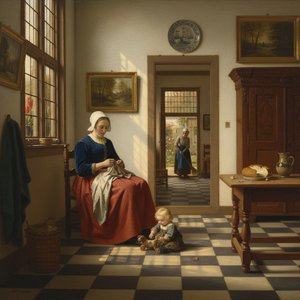
Explore the captivating world of Pieter de Hooch, a master of Dutch Golden Age painting. Discover his innovative use of light, intimate domestic scenes, and lasting influence on art history. Learn more at Most-Famous-Paintings.
Delve into the world of Francisco Goya with Most-Famous-Paintings. Explore 25 iconic paintings – from 'The Third of May' to his haunting Black Paintings. Discover the stories, techniques & emotions behind these Spanish masterpieces. Find museum-quality art reproductions for your home at Most-Famous-Paintings.com!

Journey into the Dutch Golden Age! Explore 10 iconic paintings by Rembrandt, Vermeer & Hals. Discover the stories behind these Baroque masterpieces and find museum-quality art reproductions to elevate your home decor on .
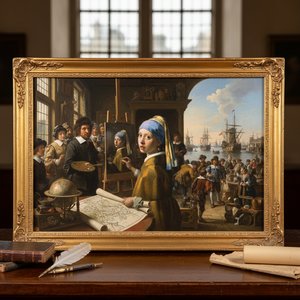
Explore the Dutch Golden Age of painting! Discover key artists like Vermeer & ter Borch, their innovative techniques, and the rich cultural context behind these Baroque masterpieces. Learn about collecting & appreciating this iconic art period.

Discover the captivating maritime paintings of Willem van de Velde the Elder, a master chronicler of the Dutch Golden Age. Explore his unparalleled realism and lasting influence on naval art history.


Stay updated with the latest art news, exclusive offers, and decoration ideas.
Tell us about your project and our art experts will provide you with 3 personalized art suggestions.
Let Us Curate 3 Options Just for You - Free!


 Buy print
 Send
Send Share
Share
 Details

 Download
 Similars
 X-Ray
X-Ray Diaporama
 Read More







 Glass option is only available in size under 110 CM