x


 Acrylic On CanvasWallArtDutch Golden Age
 1659
1659 92.0 x 100.0 cm
 Staatliche Museen
Hand-painted oil on canvas in your size and frame, made to order by our artists.





























Pick from our preset sizes that match the artwork's original proportions.

You may enter your own dimensions to fit a specific frame or space. If your selected size does not match the original image's proportions, we will either crop the artwork or extend the painting with additional hand-painted elements. A digital mockup will be sent for your approval before production begins.
Please note that the on-screen preview does not reflect the actual cropping or extension. Only the mockup will accurately show the final composition.
While custom sizes are available, we recommend selecting a dimension from the predefined list to preserve the original proportions.
Worldwide Delivery () in 3/4 weeks instead of standard 5 weeks. (18 July). No compromise on quality.


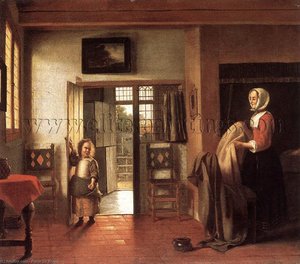
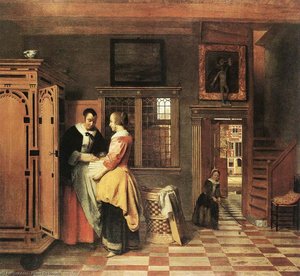
Mother Lacing Her Bodice beside a Cradle
Reproduction Size
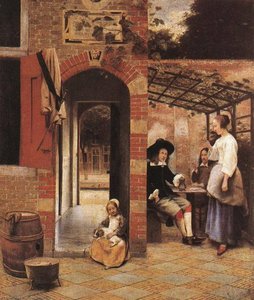
Pieter de Hooch’s “Mother Lacing Her Bodice beside a Cradle,” painted in 1659, stands as a quintessential emblem of Dutch Golden Age domestic tranquility and artistic sophistication. This intimate portrait captures a fleeting moment of maternal care amidst the quiet elegance of a bourgeois home—a scene meticulously rendered with masterful observation and imbued with subtle symbolic resonance.
Subject Matter & Composition: The painting depicts a woman seated in a chair, diligently fastening up her bodice while tending to her infant child nestled within a cradle. A man stands discreetly beside her, adding depth to the composition and hinting at the familial bonds central to the artwork’s narrative. De Hooch skillfully employs perspective—the “doorkijkje,” or peep-through window—to create an illusion of space and invite the viewer's gaze beyond the confines of the room into a softly illuminated corridor.
Style & Technique: Characteristic of de Hooch’s oeuvre, this piece exemplifies his signature style – characterized by painstaking realism combined with atmospheric lighting. He employs chiaroscuro—the dramatic interplay between light and shadow—to sculpt the figures and surfaces, creating an illusion of depth that draws the eye inward. The artist's brushstrokes are delicate yet confident, capturing textures with remarkable precision, particularly evident in the fabric folds of the woman’s dress and the cradle cover.
Historical Context: Created during the Dutch Golden Age (approximately 1648-1702), “Mother Lacing Her Bodice” reflects the burgeoning ideals of the emerging middle class—a period marked by a fascination with domestic life, family values, and idealized representations of motherhood. De Hooch’s work aligns closely with the artistic currents championed by Rembrandt and Jacob van Ruysdael, who similarly prioritized capturing everyday scenes with psychological insight.
Symbolism & Emotional Impact: Beyond its visual beauty, the painting carries significant symbolic weight. The lace symbolizes femininity and nurturing—the woman’s deliberate act of fastening her bodice represents a dedication to protecting and caring for her child. The open doorway signifies openness, connection to the outside world, and the passage of time. Most importantly, “Mother Lacing Her Bodice” evokes a profound sense of warmth, tenderness, and domestic serenity—a timeless portrayal of maternal devotion that continues to resonate with viewers today.
Further Research: For more information on Pieter de Hooch’s life and artistic legacy, consult Wikipedia's comprehensive list of his paintings. You can also explore Most-Famous-Paintings’s database for high-quality reproductions and detailed artistic analysis.


1629 - 1694 , Netherlands
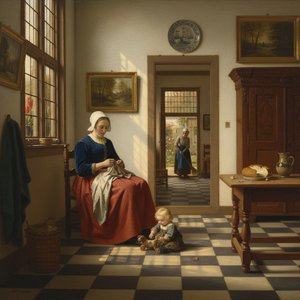
Explore the captivating world of Pieter de Hooch, a master of Dutch Golden Age painting. Discover his innovative use of light, intimate domestic scenes, and lasting influence on art history. Learn more at Most-Famous-Paintings.

APS ofrece reproducciones de bellas artes y encargos personalizados desde 2004. Confían en nosotros corporaciones, hoteles y coleccionistas selectos para obras de arte de calidad museística, servicio discreto y soluciones artísticas completas. ¡Póngase en contacto con nosotros para obtener un presupuesto personalizado!
Delve into the world of Francisco Goya with Most-Famous-Paintings. Explore 25 iconic paintings – from 'The Third of May' to his haunting Black Paintings. Discover the stories, techniques & emotions behind these Spanish masterpieces. Find museum-quality art reproductions for your home at Most-Famous-Paintings.com!

Journey into the Dutch Golden Age! Explore 10 iconic paintings by Rembrandt, Vermeer & Hals. Discover the stories behind these Baroque masterpieces and find museum-quality art reproductions to elevate your home decor on .
Explore the Dutch Golden Age of painting! Discover key artists like Vermeer & ter Borch, their innovative techniques, and the rich cultural context behind these Baroque masterpieces. Learn about collecting & appreciating this iconic art period.


Stay updated with the latest art news, exclusive offers, and decoration ideas.
Tell us about your project and our art experts will provide you with 3 personalized art suggestions.
Let Us Curate 3 Options Just for You - Free!


 Buy print
 Send
Send Share
Share
 Details

 Download
 Similars
 X-Ray
X-Ray Diaporama
 Read More







 Glass option is only available in size under 110 CM